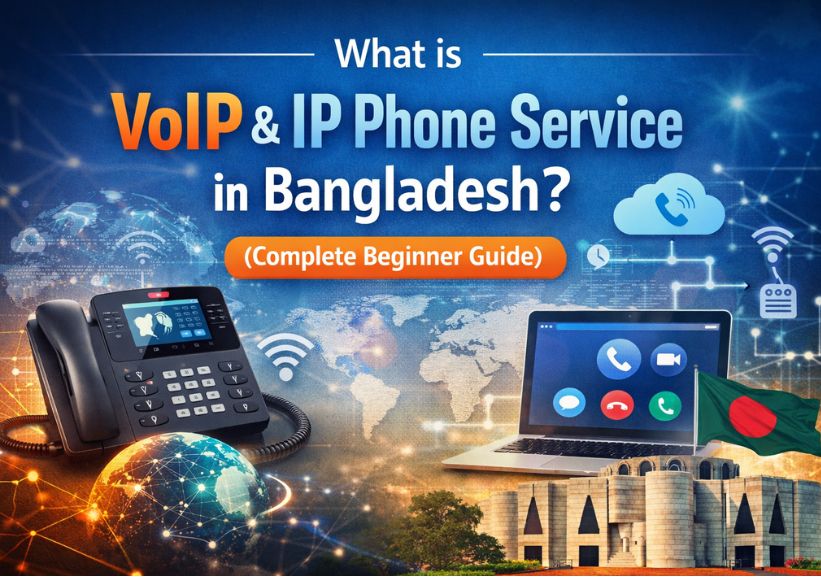
What is VoIP & IP Phone Service in Bangladesh? (Complete Beginner Guide)
- By Anis Ur Rahman
- 10 Apr, 2026
Phone calls used to be expensive. You paid for every minute. Every international call felt like burning money but that model is changing fast — especially in Bangladesh.
VoIP is the technology behind this shift. It stands for Voice over Internet Protocol. Simply put, it lets you make phone calls through your internet connection instead of a traditional phone line. This guide breaks down what VoIP is, how it works, who uses it in Bangladesh, and why your business should care.
Who Uses VoIP in Bangladesh?
VoIP is not just for big corporations. It serves a wide range of users across Bangladesh.
Businesses and call centers in Dhaka and Chittagong use it to handle hundreds of daily calls at a fraction of the traditional cost. Freelancers and remote workers rely on it to communicate with international clients without paying steep international rates.
Small businesses use it to replace expensive PSTN lines with flexible, scalable systems. Hospitals, NGOs, and e-commerce companies use it to manage internal and customer-facing communication more efficiently.
Bangladesh had over 129 million internet subscribers as of 2024, according to BTRC data. That is a massive foundation for internet-based calling to grow on — and growth is exactly what is happening.
What is Voice over Internet Protocol?
VoIP converts your voice into small digital data packets. Those packets travel over the internet just like an email or a video stream. When they reach the other person, the system reassembles them into clear, audible sound.
Think of it this way. A traditional phone call is like sending a letter through the post. VoIP is like sending that same message over WhatsApp — faster, cheaper, and far more flexible.
A typical VoIP system includes a few key components:
IP phones or softphones — hardware handsets or software apps that handle calls
VoIP gateway — converts digital signals to traditional phone lines when needed
Session Initiation Protocol (SIP) — the standard protocol that manages call setup and teardown
Internet connection — the foundation everything runs on
Cloud PBX — manages extensions, call routing, voicemail, and IVR menus
You do not need to understand every component. You just need to know that together, they replace your old phone system with something smarter and cheaper.
How Does Internet-Based Calling Work?
Here is what happens the moment you make a VoIP call.
Step 1 — You speak. Your voice is captured by a microphone on your IP phone, headset, or laptop.
Step 2 — Your voice is digitized. A codec compresses the audio into small data packets. Common codecs include G.711 and G.729.
Step 3 — Packets travel over the internet. They move through your broadband or fiber connection toward the destination.
Step 4 — Packets are reassembled. The receiving device reconstructs the audio in real time.
Step 5 — The call connects. Whether it is another VoIP user or a regular mobile number, the conversation flows normally.
The entire process happens in milliseconds. On a good connection, VoIP call quality is indistinguishable from a traditional phone line — often better.
Why IP Phone Service Matters for Bangladeshi Businesses
Cost savings are the most obvious reason to switch. But the real advantage goes deeper than that.
A real example from Dhaka: A mid-sized BPO firm based in Mirpur switched from a traditional PSTN setup to a cloud-based VoIP system in 2023. The results were significant. They cut monthly telecom costs by 60%. They connected 45 agents through one cloud PBX. The full deployment took just three days. Remote agents in Gazipur and Narayanganj joined the same system with zero additional infrastructure. No rewiring. No hardware upgrade. Just an internet connection and a softphone.
This is what VoIP delivers that PSTN simply cannot match:
Scale from 5 to 500 users without touching your office wiring
Use virtual numbers with local Bangladeshi or international area codes
Access call analytics, recordings, and IVR from one dashboard
Enable remote work without sacrificing call quality
Integrate with CRM platforms like Zoho, HubSpot, or Salesforce
For any business making more than 50 calls a day, switching to VoIP is not a technology decision. It is a financial one.
What is VoIP BPO?
VoIP BPO refers to Business Process Outsourcing companies that use VoIP infrastructure as their core communication tool.
In practice, a Dhaka-based call center handles support calls for a UK retailer using cloud telephony, SIP trunks, and IP phones — without either side paying international call rates. The call sounds local. The cost is minimal.
Bangladesh is well-positioned for this market. The country offers a large English-speaking workforce, lower labor costs compared to India or the Philippines, BTRC-licensed VoIP operators providing regulated service, and improving fiber broadband coverage in urban areas.
VoIP BPO is not limited to customer support calls either. It covers technical helpdesks, virtual assistants, lead generation, and back-office processing — all built on internet-based calling infrastructure.
IP Telephony Service in Bangladesh: What You Need to Know
IP telephony is the broader category. VoIP sits inside it. Other technologies under this umbrella include:
SIP trunking — connects your existing office phone system to the internet via SIP lines
Hosted PBX — your phone system lives in the cloud with no hardware to maintain
Unified Communications — voice, video, messaging, and file sharing combined in one platform
WebRTC — browser-based calling with no app download required
In Bangladesh, the Bangladesh Telecommunication Regulatory Commission (BTRC) oversees VoIP licensing. Operators like Grameenphone and Robi now offer VoIP-compatible services. Global platforms like Twilio, Vonage, and RingCentral also serve Bangladeshi businesses for international operations.
One important note: unlicensed VoIP for PSTN bypass remains regulated in Bangladesh. Always use a BTRC-approved provider for any commercial operation. This protects your business legally and ensures call quality standards are met.
Read our complete guide on Best IP Number Providers in Bangladesh (2026) to compare top VoIP services.”
Frequently Asked Questions About VoIP & IP Phone Service in Bangladesh
Is VoIP legal in Bangladesh?
Yes, VoIP is legal in Bangladesh when used through licensed providers approved by the Bangladesh Telecommunication Regulatory Commission (BTRC). Unlicensed VoIP for commercial use is restricted and may lead to legal penalties.
What internet speed do I need for VoIP?
You need at least 100 Kbps per call for VoIP in Bangladesh, with a stable 5 Mbps connection recommended for small offices. Fiber internet provides better call quality with lower latency and jitter.
Can I use VoIP on my mobile phone?
Yes, you can use VoIP on mobile phones using softphone apps like Zoiper or Linphone on Android and iOS.
You can make and receive calls over Wi-Fi or mobile data easily.
What is the difference between VoIP and traditional phone systems?
VoIP uses the internet to transmit voice data, while traditional phone systems use dedicated PSTN lines. VoIP is more cost-effective, scalable, and flexible compared to traditional landlines.
Which VoIP providers are available in Bangladesh?
For local use, choose a BTRC-licensed SIP trunk or hosted PBX provider. For international and BPO operations, platforms like Twilio and Vonage work well. Always verify BTRC compliance before signing up.
Final Thoughts on VoIP in Bangladesh
VoIP is not a future technology for Bangladesh. It is the present infrastructure that thousands of businesses are already running on. Whether you run a two-person startup or a 200-seat call center, internet-based calling gives you more capability at a lower cost than any traditional phone system can match. The only question is how long you wait before making the switch.

Author By
Anis Ur Rahman
Anis Ur Rahman writes domain and web hosting–related articles on behalf of Ummah Host BD. He works with domain name selection, web hosting, BDIX hosting, and website performance, and creates informational guides based on practical experience to help users make informed decisions. His writing focuses on providing reliable, easy-to-understand, and decision-supportive content.