How SMS Marketing Works for Businesses in 2026
- By Anis Ur Rahman
- 17 May, 2026
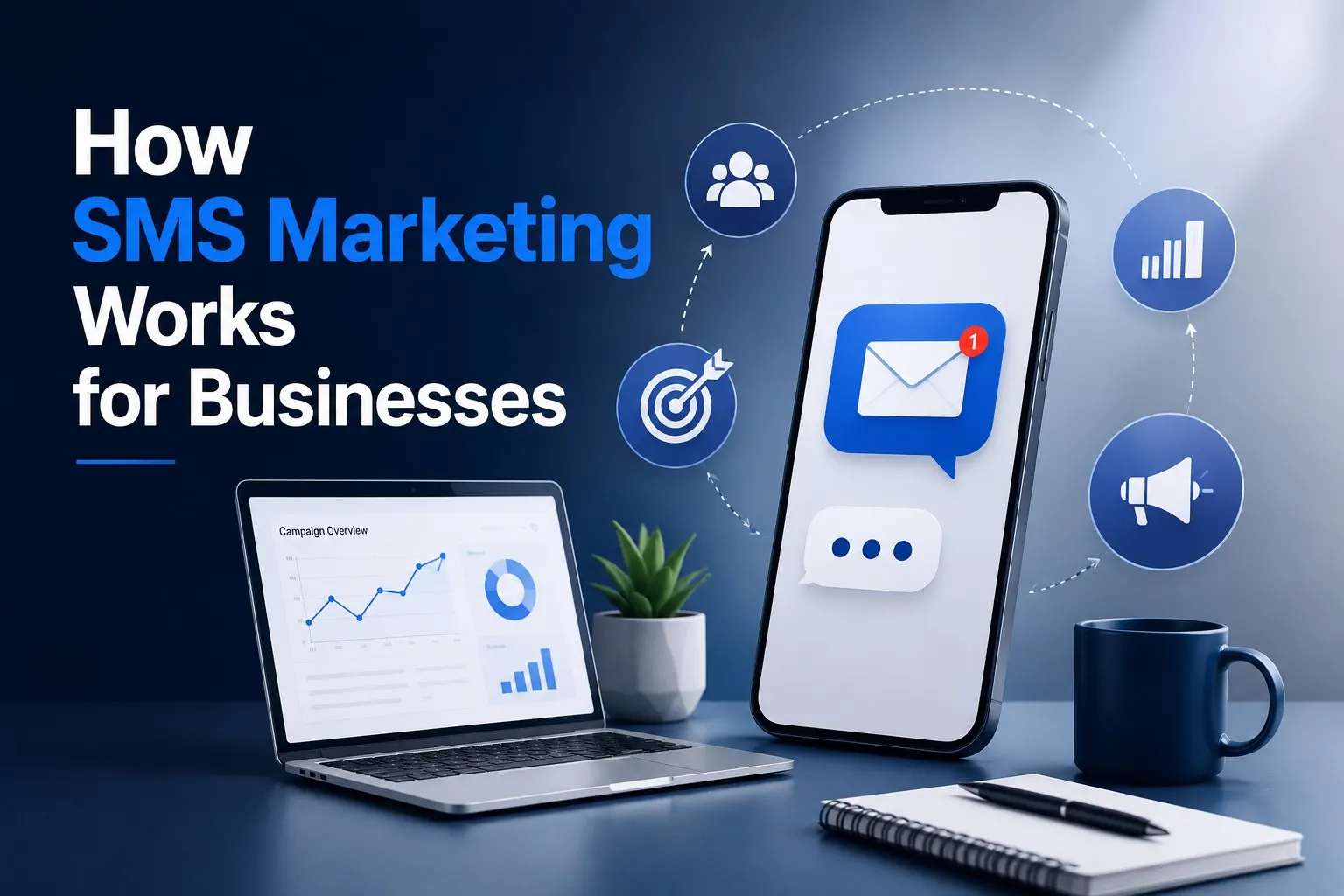
Your customers check their texts within 3 minutes. They check their email — maybe once a day. That gap explains why SMS marketing is now one of the highest-ROI channels for businesses of every size. Here's exactly how SMS Marketing Works for Businesses — and how to start.
What Is SMS Marketing?
SMS marketing means sending promotional or transactional text messages directly to customers who opted in. No algorithm. No spam folder. Just a direct line to someone's phone.
Businesses use it for:
Flash sales and limited-time offers
Appointment reminders and confirmations
Order updates and shipping alerts
Loyalty rewards and VIP deals
Winning back inactive customers
It's the most direct form of mobile marketing available today. And unlike social ads, it doesn't depend on reach you have to pay for repeatedly.
Explore More: What Is Masking SMS Service in 2026
How Does SMS Marketing Work?
Here's the full picture — step by step.
Step 1: Build Your Opt-In List
You cannot text people without consent. In the US, TCPA regulations require explicit opt-in before any marketing message. This opt-in happens through:
Website sign-up forms
Keyword campaigns ("Text SAVE to 55555")
Checkout checkboxes
In-store QR codes
This legal requirement is actually an advantage. Every person on your list *wants* to hear from you. That's why SMS converts so well.
Step 2: Choose an SMS Marketing Platform
You need a dedicated SMS marketing platform to send at scale. Top options include:
Klaviyo — best for Shopify eCommerce brands
Attentive — strong personalization for retail
SimpleTexting — solid for small businesses
Twilio — developer-friendly API solution
EZTexting — great for service businesses
These platforms manage compliance, message delivery, automation, and analytics in one place. Choose a platform that works smoothly with your existing business tools and workflows.
Step 3: Write a Message That Works
Standard SMS is 160 characters. Every word counts.
A high-converting SMS message includes:
Your brand name — so they know who's texting
One clear action — buy, book, reply, click
A reason to act now — limited stock, expires tonight
Opt-out instructions — let users unsubscribe easily with messages like “Reply STOP to opt out” (required for compliance).
Step 4: Send — Bulk or Triggered
Two send types drive most SMS campaigns:
Bulk SMS — One message to your full list or a segment. Used for sales, launches, and announcements.
Triggered SMS — A message fires automatically when a customer acts — abandons a cart, books an appointment, makes a purchase. These convert best because the timing is always relevant.
Smart businesses use both. Broadcasts build awareness, while automations convert.
Why Is SMS Marketing Effective?
The numbers make a clear case:
Sources: SMS marketing statistics 2026
But data alone doesn't tell the full story. SMS works because it bypasses intent friction. When someone clicks a link from a text, they're already warm. The channel self-selects for engaged customers. Email open rate data also became unreliable after Apple's Mail Privacy Protection in 2021. SMS hasn't changed. It still delivers.
Is SMS Marketing Still Effective in 2026?
Yes — and the gap is widening in SMS's favor. Email open rate data collapsed after Apple's Mail Privacy Protection (2021). Social reach keeps shrinking without paid spend. SMS hasn't changed. It still delivers directly, every time.
What wins now:
Segmented lists — target what each group actually cares about
Personalized copy — first names, past purchase references
Smart timing — send when your customer is most likely to act
Two-way messaging — conversations convert better than broadcasts
Explore More: SMS Marketing vs Email Marketing in Bangladesh
How Do Businesses Send Bulk SMS?
Choose a business bulk SMS platform with a bulk-send dashboard
Upload or sync your subscriber list via CRM or eCommerce integration
Segment by location, behavior, or purchase history
Write, schedule, and send
Track delivery rate, clicks, and conversions in real time
Platforms like Klaviyo, HubSpot, and Shopify integrations make this seamless — campaigns trigger off real customer data, not guesswork.
What to Look for in an SMS Advertising Service
Evaluate any SMS advertising service on these six criteria:
Compliance tools — handles opt-ins, opt-outs, quiet hours automatically
Two-way messaging — customers can reply
Segmentation — target by behavior and purchase data
A/B testing — test copy and timing
Integrations — plugs into your existing stack
Revenue analytics — tracks money, not just opens
Cost runs $20–$500/month depending on volume. Most eCommerce brands report $10–$30 revenue per SMS sent with well-run campaigns.
SMS Marketing in Bangladesh
Bangladesh has over 180 million mobile subscribers. Internet access is still patchy outside Dhaka and Chittagong — but mobile coverage reaches almost every corner of the country. That's the core opportunity. SMS works on any handset, anywhere, without Wi-Fi. For Bangladeshi businesses, it's often the most reliable direct channel available.
BTRC Compliance: What You Must Know
All commercial bulk SMS in Bangladesh is regulated by the Bangladesh Telecommunication Regulatory Commission (BTRC). The key rules:
Use BTRC-approved aggregators — not personal SIMs.
Include a registered sender ID with every promotional message
Always provide an opt-out option
Unsolicited bulk SMS can lead to fines and service suspension
Work only with licensed, compliant aggregators. Non-compliance is both a legal and brand risk.
Local SMS Platforms to Know
Ummah Host BD — largest aggregator in BD, trusted by banks and telecoms
Reve Systems — strong for enterprise and two-way messaging
Twilio (international routing) — used by Dhaka-based tech startups
Ummah Host BD and Reve Systems are the practical starting points for most local businesses. Both are BTRC-compliant and support Bangla-language SMS.
Explore Full Guide: Bulk SMS Service in Bangladesh for Business Marketing
How BD Businesses Use SMS Today
eCommerce brands like Chaldal, Shajgoj, and Daraz BD send order confirmations, delivery alerts, and flash sale messages via SMS — because many customers don't rely on email at all.
Retail businesses run bulk SMS campaigns around Eid-ul-Fitr and Eid-ul-Adha, when consumer spending peaks sharply. MFS providers like bKash and Nagad send transactional SMS for every payment. Customers now expect it. It's a trust signal, not just a notification. The market is still early and competition is weak. Businesses building clean opt-in lists and sending personalized, timely messages — in Bangla or English — are already pulling ahead.
Frequently Asked Questions About How SMS Marketing Works for Businesses
What is mobile SMS marketing?
It's sending promotional or transactional texts to customers who opted in. Governed by BTRC in Bangladesh and TCPA in the US — explicit consent is required before any message is sent.
How often should businesses text customers?
2–4 times per month for promotions. Transactional texts (orders, reminders) can be more frequent. Over-texting is the #1 cause of unsubscribes.
Is SMS marketing legal in Bangladesh?
Yes — when sent through BTRC-approved aggregators, with a registered sender ID and a clear opt-out option. Unsolicited bulk SMS risks fines and suspension.
What ROI should I expect?
Global benchmarks from Klaviyo and Attentive show $10–$30 revenue per SMS for eCommerce. In Bangladesh, service businesses see strong ROI just from reducing appointment no-shows.
The Bottom Line
SMS Marketing Works for Businesses because it meets people where they already are — on their phones, in their messages app, within minutes.
The businesses winning with it aren't blasting generic texts. They're earning opt-ins, personalizing their messages, and timing every send with intent. Pick a platform, build your list and send messages worth reading.
The results often come faster than expected
Learn More:
Bulk SMS Providers in Bangladesh

Author By
Anis Ur Rahman
Anis Ur Rahman writes domain and web hosting–related articles on behalf of Ummah Host BD. He works with domain name selection, web hosting, BDIX hosting, and website performance, and creates informational guides based on practical experience to help users make informed decisions. His writing focuses on providing reliable, easy-to-understand, and decision-supportive content.
Search Blog
Categories
- Problem Solving 2
- RDP Hosting 4
- SMS Service 17
- IP Number 11
- Reseller Hosting 5
- Promo Offer 2
- Achieve 3
- SSD Hosting 5
- cPanel Hosting 7
- BDIX Hosting 7
- Email Hosting 4
- Dedicated Server 7
- User Guide 0
- Security 4
- Online security 6
- Business 5
- SEO 3
- VPS Hosting service 31
- Manage Hosting 1
- domain hosting service 28
- Domain 1
- Hosting 40