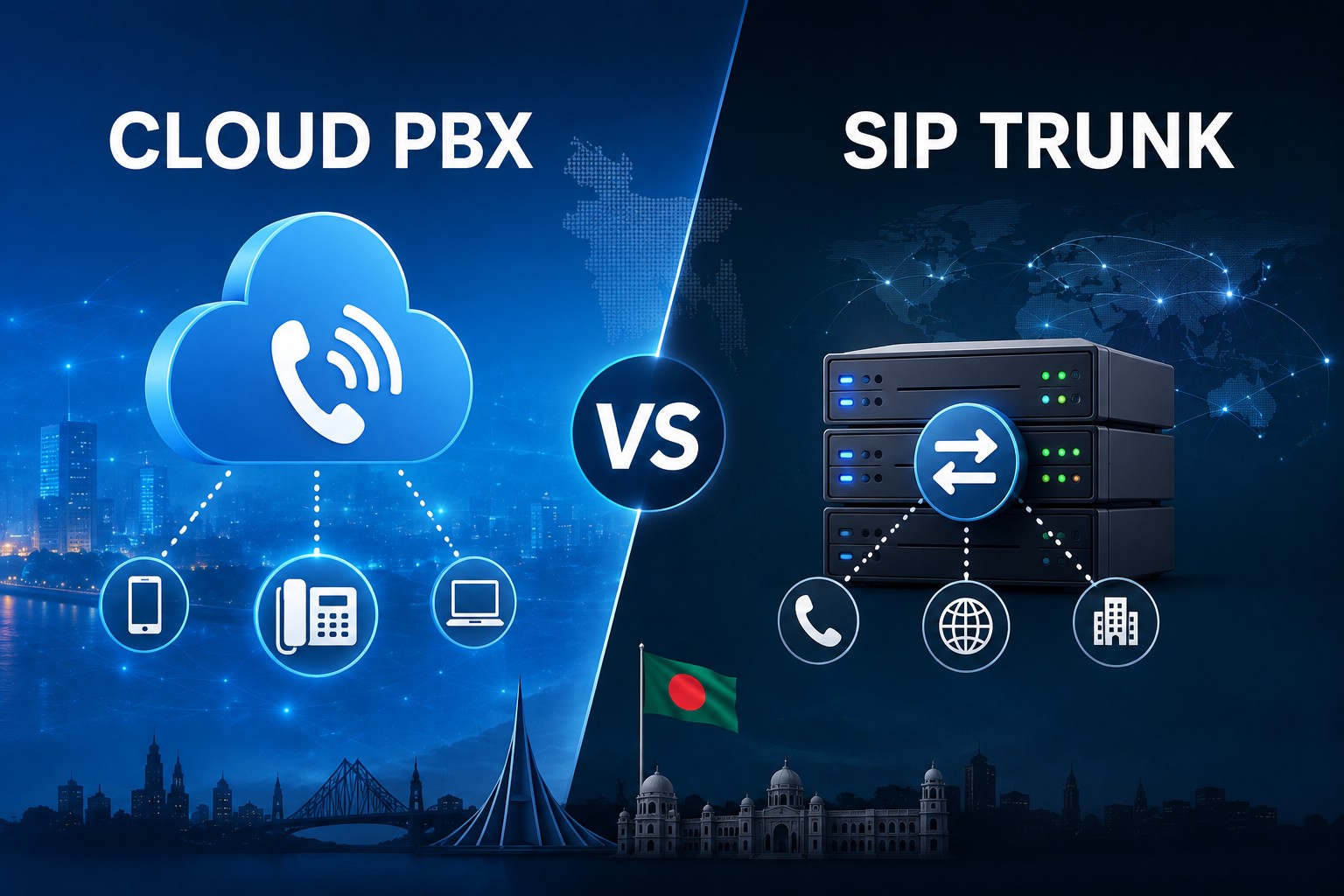
Cloud PBX vs SIP Trunk in Bangladesh — Which Is Best for Your Business ?
- By Anis Ur Rahman
- 20 Apr, 2026
Published: 26 August, 2026 | Reading Time: 10 Minutes
Quick Answer: Cloud PBX is best for small and mid-sized businesses that want a simple, hardware-free setup. SIP trunking suits larger companies with an existing PBX that want lower call costs. Keep reading to find out which one fits your situation.
What Is Cloud PBX?
PBX stands for Private Branch Exchange. It's the system that routes calls inside your business and connects you to outside lines.
A hosted PBX in Bangladesh moves everything to the cloud. A third-party provider manages the servers, routing, and maintenance. You just connect your phones — IP phones, mobile apps, or softphones — to the internet.
Think of it like electricity. Instead of buying your own generator, you plug into the grid, pay a monthly bill, and let the utility handle everything.
Cloud PBX typically includes:
Auto-attendant and IVR menus
Call routing and forwarding across branches
Voicemail to email
Conference calling
Mobile app for remote staff
CRM integrations (Zoho, HubSpot, Salesforce)
Instant scalability — add lines in minutes
What Is a SIP Trunk?
SIP stands for Session Initiation Protocol. It's the technology that carries voice calls over the internet — replacing your traditional phone lines (PSTN or ISDN).
A SIP trunk is a virtual phone line. It connects your existing on-premise PBX to the internet. Instead of paying for multiple physical lines, one SIP connection handles many simultaneous calls. Here's a simple analogy. Your old PBX is a car. A SIP trunk is building a direct road to the internet — replacing expensive toll roads (your analog lines).
Is SIP Trunk the Same as VoIP?
Not exactly — but they're closely related. VoIP (Voice over Internet Protocol) is a broad technology that converts voice into digital data. SIP is a specific protocol used within VoIP to set up and manage calls. All SIP trunks use VoIP, but not all VoIP systems use SIP trunking.
Explore More: What is VoIP & IP Phone Service in Bangladesh?
What Is a VoIP Gateway in Bangladesh?
A VoIP gateway is a hardware device that bridges your traditional analog phones with modern SIP or cloud systems.
Say your office has older desk phones that don't support IP. A VoIP gateway converts its analog signals into digital data that your SIP trunk or Cloud PBX can understand. It's the translator between old technology and new.
You likely need a VoIP gateway if:
You have legacy analog phones you want to keep using
You're migrating to SIP trunking, but can't replace all hardware at once
You need a PSTN backup line during internet outages
You're running a mixed environment of old and new equipment
Popular VoIP gateway brands used in Bangladesh include Grandstream, AudioCodes, and Cisco. The Grandstream GXW series is widely used by Dhaka-based SMEs for its low cost and straightforward configuration.
Learn More: How VoIP Works in Bangladesh
Cloud PBX vs SIP Trunk in Bangladesh: Key Differences
This is where most businesses get confused. Let's lay it out clearly.
Bottom line: Cloud PBX wins on simplicity and speed. SIP trunking wins in terms of control and per-call economics at high volume.
How to Choose — Cloud PBX or SIP Trunk?
Ask Yourself These Five Essential Questions Before You Make a Decision
1. Do you already have a working on-site PBX?
If yes, SIP trunking extends its life at a low cost. If not, Cloud PBX is the faster, simpler path.
2. How many calls does your team make daily?
Low to medium volume? Cloud PBX handles it easily. High-volume call centres often benefit from the per-channel economics of SIP trunking.
3. Is Your Internet Connection Reliable?
Both systems need a stable internet connection. Each call uses about 100 Kbps, so 10 simultaneous calls require at least 1 Mbps of dedicated bandwidth, plus extra for better call quality.
4. Do you have in-house IT support?
Cloud PBX needs almost zero technical management. SIP trunking requires someone who understands PBX configuration. Be honest about your team's capability.
5. Do you need local Bangladeshi numbers?
Most hosted PBX providers in Bangladesh can assign local DID numbers with Dhaka or Chittagong area codes. Confirm this before signing any contract.
Quick Checklist Before You Buy
Stable broadband at your office (fibre preferred)
IP phones or softphone-compatible devices are ready
Provider offers local DID numbers (Dhaka/Chittagong)
SLA with a minimum 99.9% uptime guarantee
Failover routing to mobile if the internet drops
VoIP gateway sourced if you have legacy analog phones
BTRC compliance confirmed if operating a commercial call centre
FAQs About Cloud PBX vs SIP Trunk in Bangladesh
Is SIP trunk the same as VoIP?
No. VoIP is a broad technology — voice calls over the internet. SIP is a specific protocol that manages how calls start and end. A SIP trunk is a VoIP connection that uses SIP to link your PBX to the phone network.
What is a VoIP gateway?
A device that converts analog phone signals into digital VoIP data. It lets businesses keep older desk phones while connecting to a modern SIP or cloud system.
Can I get a local Bangladeshi number with hosted PBX?
Yes. Most hosted PBX providers in Bangladesh assign local DID numbers with Dhaka or Chittagong area codes. Calls route directly to your team through the cloud system.
Which is cheaper — Cloud PBX or SIP trunk?
Cloud PBX is cheaper for most SMEs. No hardware, no maintenance, predictable monthly billing. SIP trunking costs less per call at high volume but requires a higher upfront investment.
Is Cloud PBX reliable during internet outages in Bangladesh?
Yes — if you prepare. Pair it with a backup PSTN line or 4G/LTE router. Most providers support call failover, automatically routing calls to mobile if your internet drops.
Do I need BTRC approval for VoIP in Bangladesh?
For internal business use, no. For commercial call centres or reselling VoIP services, BTRC licensing applies. Consult a local telecom advisor before scaling.
Learn Our Relevant Guide:

Author By
Anis Ur Rahman
Anis Ur Rahman writes domain and web hosting–related articles on behalf of Ummah Host BD. He works with domain name selection, web hosting, BDIX hosting, and website performance, and creates informational guides based on practical experience to help users make informed decisions. His writing focuses on providing reliable, easy-to-understand, and decision-supportive content.
Search Blog
Categories
- AI Tools & Automation 3
- Problem Solving 3
- RDP Hosting 4
- SMS Service 17
- IP Number 11
- Reseller Hosting 5
- Promo Offer 2
- Achieve 3
- SSD Hosting 5
- cPanel Hosting 7
- BDIX Hosting 7
- Email Hosting 4
- Dedicated Server 7
- User Guide 0
- Security 5
- Online security 6
- Business 5
- SEO 3
- VPS Hosting service 33
- Manage Hosting 1
- domain hosting service 29
- Domain 1
- Hosting 46
Latest News
18 Oct, 2026