VoIP vs Traditional Phone System in Bangladesh: Which One Is Right for Your Business?
- By Anis Ur Rahman
- 14 Apr, 2026
Published: 25 August, 2026 | Reading Time: 10 Minutes
Switching your business phone system is a critical decision. Choose wrong, and you risk higher costs, poor call quality, and unhappy customers. This guide compares VoIP vs traditional phone systems in Bangladesh, helping you choose the right solution for your business with confidence.
What Is a Business Phone System?
A business phone system manages all your company's calls. It's not just a phone line. A proper system routes calls to the right person, records conversations, and connects your entire team — even remote workers.
In Bangladesh, businesses choose between two main options: VoIP and traditional phone systems (PSTN/PBX).
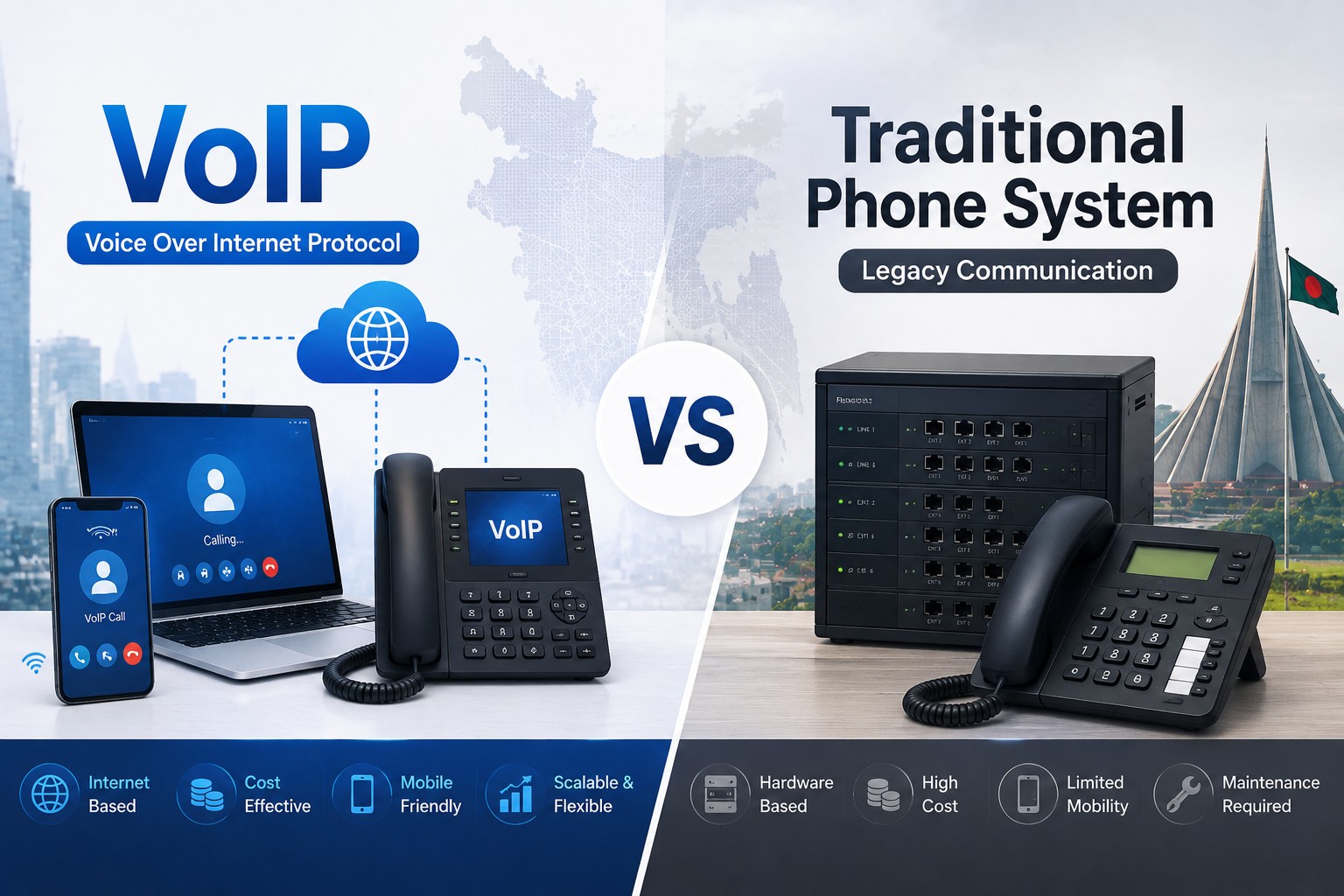
VoIP vs Traditional Phone: The Core Difference
Traditional phones use copper wire lines through BTCL or private PBX hardware. Calls travel as analog signals — no internet required.
VoIP (Voice over Internet Protocol) converts your voice into digital data and sends it over the internet. You can call from a smartphone, laptop, or IP desk phone. Simple as that. Now let's see which one actually wins for your business.
A Beginner's Guide: What is VoIP & IP Phone Service in Bangladesh?
Cost: VoIP Wins — and It's Not Close
A traditional PBX setup in Bangladesh can cost ৳50,000 to ৳3,00,000+ just for hardware and installation. Add monthly BTCL line charges and expensive ISD rates for international calls — costs pile up fast.
VoIP uses your existing internet connection. Most VoIP providers charge ৳500–2,000 per user per month. International calls? Often near-free, especially to clients in Europe or North America.
Complete Cost Guide in 2026: VoIP Price in Bangladesh
Call Quality: Traditional Has the Edge — But Not for Long
Traditional landlines don't depend on the internet. They're consistent, clear, and work even during power cuts (older POTS lines especially) that's a real advantage.
VoIP quality depends on your broadband. On a stable 10+ Mbps connection — standard in Dhaka, Chattogram, or Sylhet with Grameenphone Broadband or Summit Communications — VoIP delivers HD voice quality. In rural areas with weak connectivity, you may face lag or drops.
The honest take: If you have reliable broadband, VoIP quality matches or beats traditional. If your internet is unstable, traditional wins on reliability.
Read More: Cloud Call Center vs Traditional Call Center in 2026
Features: VoIP Isn't Even Competing — It's in a Different League
Traditional PBX gives you: call hold, transfer, basic voicemail that's mostly it.
VoIP gives you:
Auto-attendant (IVR): "Press 1 for Sales, Press 2 for Support"
Call recording for training and compliance
Mobile app — your office number works on any smartphone
Voicemail-to-email — audio files delivered to your inbox
Video calling built in, no extra software
For growing businesses, this isn't a nice-to-have. It's a competitive advantage.
Get More: VoIP for Small Business & International Calling in 2026
Scalability: VoIP Scales in Minutes, PBX Takes Days
Adding a new team member on VoIP? It's a software change — sometimes just a few clicks in a dashboard.
Adding a new line on traditional PBX? You need physical wiring, new hardware ports, and a technician visit. In some areas of Bangladesh, that means waiting days. If your business is growing fast, this difference matters more than most people realise.
Internet and Power Dependency: Traditional Phone's Real Advantage
VoIP stops working without electricity and internet. That's a genuine risk in Bangladesh, where power outages are still common.
The fix: Use a UPS (uninterruptible power supply) for your router and VoIP adapters. Also enable call forwarding to a mobile number during outages — most VoIP platforms support this. Traditional landlines often survive power cuts. For businesses in areas with unreliable infrastructure, this is worth weighing seriously.
Explore More: Benefits of VoIP for Business in Bangladesh
Is VoIP Legal in Bangladesh?
Yes — when used through licensed operators. The Bangladesh Telecommunication Regulatory Commission (BTRC) regulates VoIP services. Platforms like Zoom Phone, Microsoft Teams, and 3CX are used legally by businesses across the country.
Using unauthorized VoIP bypass routes — routing international calls as local calls — is illegal. Always use a licensed provider or a registered international platform.
Learn More: How VoIP Works in Bangladesh 2026
How to Choose: A Simple Decision Framework
Choose VoIP if:
You have stable broadband (10+ Mbps)
Make frequent international calls
Your Team works remotely or across multiple offices
You're scaling and need flexibility fast
Stick with traditional if:
Your area has unreliable internet
Operate in healthcare or emergency services requiring guaranteed uptime
You have fewer than 5 staff with simple communication needs
Many businesses in Bangladesh now run hybrid systems — traditional lines as backup, VoIP as the primary platform. It's the safest middle ground.
FAQs About VoIP vs Traditional Phone System in Bangladesh
Is VoIP cheaper than a landline in Bangladesh?
Yes. VoIP typically costs 40–70% less, especially once you factor in international call charges and PBX hardware maintenance.
What internet speed do I need for VoIP?
Minimum 5 Mbps. For HD quality with multiple simultaneous calls, aim for 10–25 Mbps. Most urban broadband plans in Bangladesh easily meet this.
Can I keep my existing business number if I switch to VoIP?
Many providers offer number porting. BTCL landline numbers may have limitations — confirm with your specific provider before switching.
What happens to VoIP during a power cut?
It stops working unless you have a UPS. Set up mobile call forwarding as a backup so you never miss a call.
Are there local VoIP providers in Bangladesh?
Yes. SSL Wireless, Ummah Host BD, and several ISPs offer SIP trunk services. International platforms like Zoom Phone and RingCentral are also available through local resellers.
Bottom line
For most urban businesses in Bangladesh, VoIP is the smarter, cheaper, and more scalable choice. Traditional systems still have a place — but that place is shrinking every year as broadband improves across the country.
Learn Our A Full Guide in 2026: Best Cheap VoIP Providers in Bangladesh in 2026

Author By
Anis Ur Rahman
Anis Ur Rahman writes domain and web hosting–related articles on behalf of Ummah Host BD. He works with domain name selection, web hosting, BDIX hosting, and website performance, and creates informational guides based on practical experience to help users make informed decisions. His writing focuses on providing reliable, easy-to-understand, and decision-supportive content.
Search Blog
Categories
- Problem Solving 3
- RDP Hosting 4
- SMS Service 17
- IP Number 11
- Reseller Hosting 5
- Promo Offer 2
- Achieve 3
- SSD Hosting 5
- cPanel Hosting 7
- BDIX Hosting 7
- Email Hosting 4
- Dedicated Server 7
- User Guide 0
- Security 4
- Online security 6
- Business 5
- SEO 3
- VPS Hosting service 33
- Manage Hosting 1
- domain hosting service 29
- Domain 1
- Hosting 43