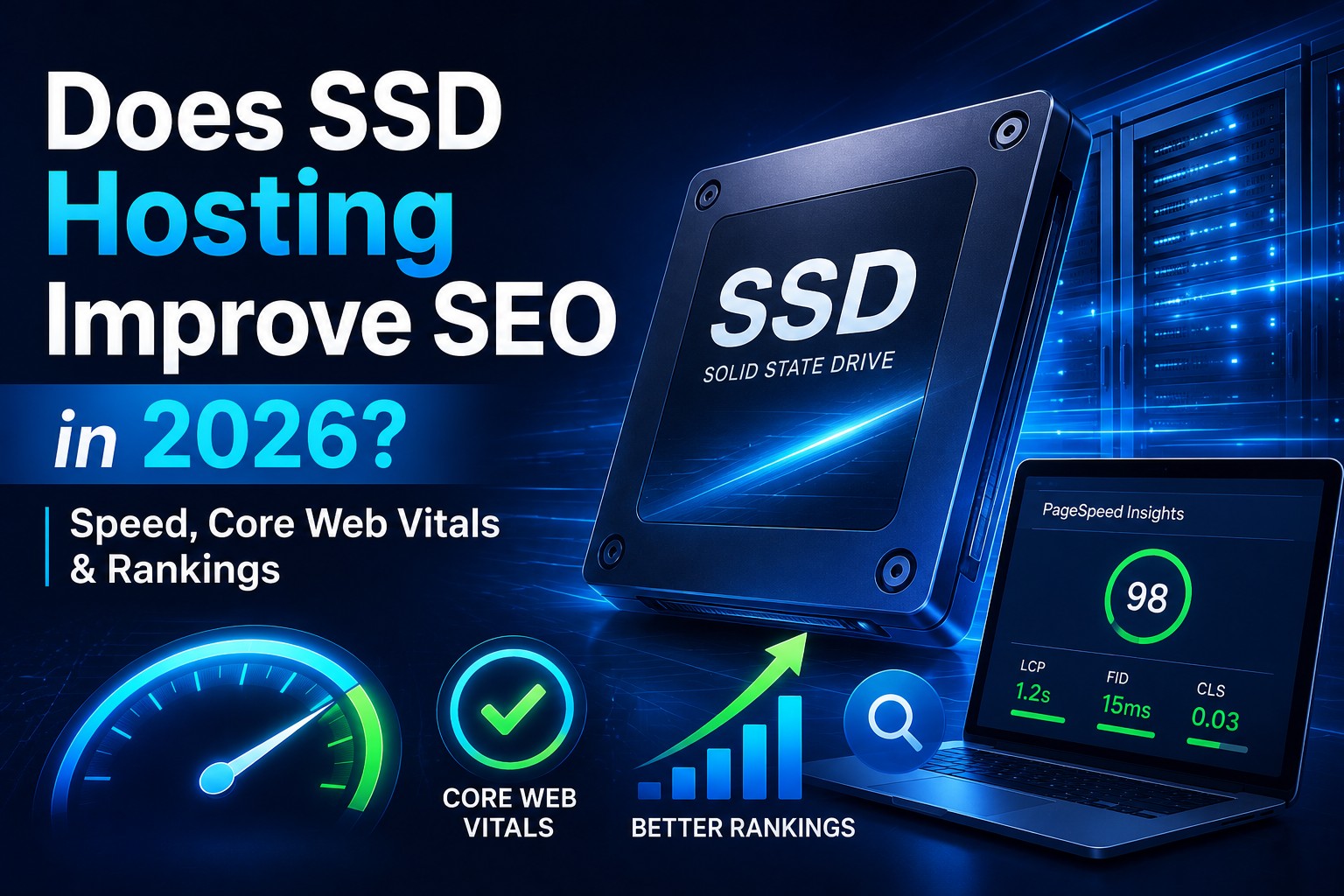
Does SSD Hosting Improve SEO in 2026? Speed, Core Web Vitals & Rankings
- By Anis Ur Rahman
- 08 Jan, 2026
Last updated: 30 July 2026 | Read Time: 8 Minutes
If you search for hosting today, you’ll see one promise everywhere: “SSD Hosting Improves SEO in 2026.” But what does that really mean in 2026? Does Google reward SSDs directly, or is something else going on?
Let’s answer this clearly, with evidence, real metrics, and practical advice you can use. Most website owners ask the wrong question.
They ask: “Does SSD hosting boost rankings?”
The better question is:What does Google actually measure when ranking pages?
Yes, SSD hosting can improve SEO indirectly in 2026 by improving page speed, Core Web Vitals, and user experience—all of which influence rankings. SSD itself is not a ranking factor. But the performance outcomes it enables absolutely matter.
In this guide, we’ll break down:
Page load speed
Core Web Vitals (2026 version)
Server response time (TTFB)
Real-world performance at scale
When SSD hosting does nothing for SEO
Does Hosting Affect SEO Rankings?
Yes—but not in the way most marketing pages claim.
Key facts:
Hosting type ≠ direct ranking factor
Hosting performance metrics = ranking signals
Google evaluates outcomes, not hardware labels
According to Google, ranking systems look at how pages perform for users. They do not check whether your disk is SSD, NVMe, or HDD.
Cause → Effect → Metric
Better hosting → faster delivery
Faster delivery → better performance metrics
Better metrics → stronger SEO signals
That’s the real chain Google follows.
What Is SSD Hosting?
SSD hosting uses Solid State Drives instead of traditional hard disks.
SSD vs HDD in one paragraph:
HDDs store data on spinning disks with mechanical arms. SSDs use flash memory with no moving parts. That makes SSDs much faster at reading and writing data.
Why this matters today:
Modern sites are dynamic
CMS platforms load databases constantly
E-commerce and blogs rely on many small files
For platforms like WordPress and WooCommerce, faster disk access means smoother performance under load.
Page Load Speed: How SSD Hosting Influences It
Is page speed a Google ranking factor?
Yes—through user experience and Core Web Vitals. SSD hosting improves page speed by reducing disk latency.
Here’s how that plays out in practice:
HTML files load faster
CSS and JavaScript are served more quickly
Database queries return sooner
SEO logic chain:
SSD → Faster disk I/O → Faster page load → Better Core Web Vitals → SEO lift
A 2026 case study from a regional hosting provider in South Asia showed:

HDD shared hosting: ~3.1s load time
SSD shared hosting (same server): ~1.9s load time
That’s a 38% speed improvement without changing content.
Explore More: SSD vs HDD Speed Comparison for Web Hosting in 2026
Core Web Vitals & SSD Hosting (2026 Context)
Core Web Vitals still matter in 2025, but they’ve evolved.
SSD hosting can help with:
LCP (Largest Contentful Paint):
Faster delivery of images and hero elements.
INP (Interaction to Next Paint):
Quicker server responses improve interaction speed.
CLS (Cumulative Layout Shift):
Indirect benefit when pages load predictably.
Important expert nuance:
SSD alone does not guarantee good Core Web Vitals.
You also need:
Proper server configuration
Caching
Optimized themes and scripts
Overselling SSDs hurts trust. Google rewards accuracy.
Server Response Time (TTFB): Does SSD Reduce It?
Does SSD reduce server response time?
Sometimes, when disk access is the bottleneck.
TTFB (Time to First Byte) measures:
Request processing
Database calls
Server readiness
SSD helps when:
Your site makes frequent database reads
Disk I/O is slowing responses
But the SSD is only one piece.
Other major factors:
CPU performance
Available RAM
Server location
Caching layers
SSD hosting can reduce server response time when disk access is a bottleneck, but CPU, RAM, caching, and server location also matter.
Website Performance at Scale (Traffic, Plugins, Databases)
SSD hosting shines when traffic grows.
High-impact use cases:
WooCommerce stores
LMS platforms
News portals
Membership sites
These sites run:
Many database queries
Heavy plugins
Frequent writing and reading
In a local Bangladeshi news site example:
HDD hosting crashed at ~1,200 concurrent users
SSD hosting handled ~2,000 users smoothly
Same code. Same content. Different disk performance.
This is where SEO and hosting truly connect—through reliability.
Explore More: SSD Hosting Cost vs HDD Hosting in 2026
User Experience & Behavioral SEO Signals
Does faster hosting reduce bounce rate?
In most cases, yes.
Faster pages lead to:
Lower bounce rates
Longer dwell time
Better mobile engagement
Google doesn’t rank sites because users behave well. But user behavior reflects page quality and satisfaction.
Think of it this way:
Users leave slow sites
Google sees poor engagement
Rankings slip over time
SSD hosting supports the UX foundation your content needs.
Explore More: How to Optimize Your Website for SEO in 2026
SSD vs NVMe: Does It Matter for SEO in 2026?
NVMe is faster than a standard SSD.
Differences:
SSD: ~500 MB/s
NVMe: 3,000+ MB/s
When NVMe helps SEO:
Very large databases
High-traffic e-commerce
Complex queries
When it’s overkill:
Small blogs
Low-traffic sites
Well-cached pages
For most sites, SSD + good optimization beats NVMe alone.
Read More: NVMe SSD vs SATA SSD Hosting in 2026
When SSD Hosting Will NOT Improve SEO
This part matters for trust.
SSD hosting won’t fix:
Thin or copied content
Poor internal linking
Weak backlinks
Bloated themes
No caching or CDN
Google rewards overall quality, not isolated upgrades. Hardware supports SEO. It does not replace strategy.
Practical Checklist: How SSD Hosting Improve SEO in 2026
Use this checklist to turn SSD into real SEO gains:
SSD or NVMe storage
LiteSpeed or NGINX server
Server-side caching
CDN enabled
Image compression
Clean, lightweight themes
Database optimization
This is a how-to schema ready and practical.
Final Verdict: Is SSD Hosting Worth It for SEO in 2026?
Let’s be precise.
SSD ≠ direct ranking factor
SSD = performance enabler
SEO impact depends on execution
One-sentence takeaway:
In 2026, SSD hosting helps SEO indirectly by delivering faster load times and better performance metrics that matter to Google and real users.
If your site is serious about growth, SSD hosting is no longer optional. It’s the baseline.
FAQ Section
Does hosting type affect Google rankings?
Indirectly. Google ranks based on performance and UX outcomes, not hosting labels.
Is SSD hosting enough to rank higher?
No. You still need strong content, links, and technical SEO.
Is NVMe better than SSD for SEO?
Only for high-traffic or database-heavy sites.
Can shared SSD hosting still help SEO?
Yes, if the server is well-optimized and not overcrowded.

Author By
Anis Ur Rahman
Anis Ur Rahman writes domain and web hosting–related articles on behalf of Ummah Host BD. He works with domain name selection, web hosting, BDIX hosting, and website performance, and creates informational guides based on practical experience to help users make informed decisions. His writing focuses on providing reliable, easy-to-understand, and decision-supportive content.
Search Blog
Categories
- Problem Solving 3
- RDP Hosting 4
- SMS Service 17
- IP Number 11
- Reseller Hosting 5
- Promo Offer 2
- Achieve 3
- SSD Hosting 5
- cPanel Hosting 7
- BDIX Hosting 7
- Email Hosting 4
- Dedicated Server 7
- User Guide 0
- Security 4
- Online security 6
- Business 5
- SEO 3
- VPS Hosting service 32
- Manage Hosting 1
- domain hosting service 29
- Domain 1
- Hosting 40