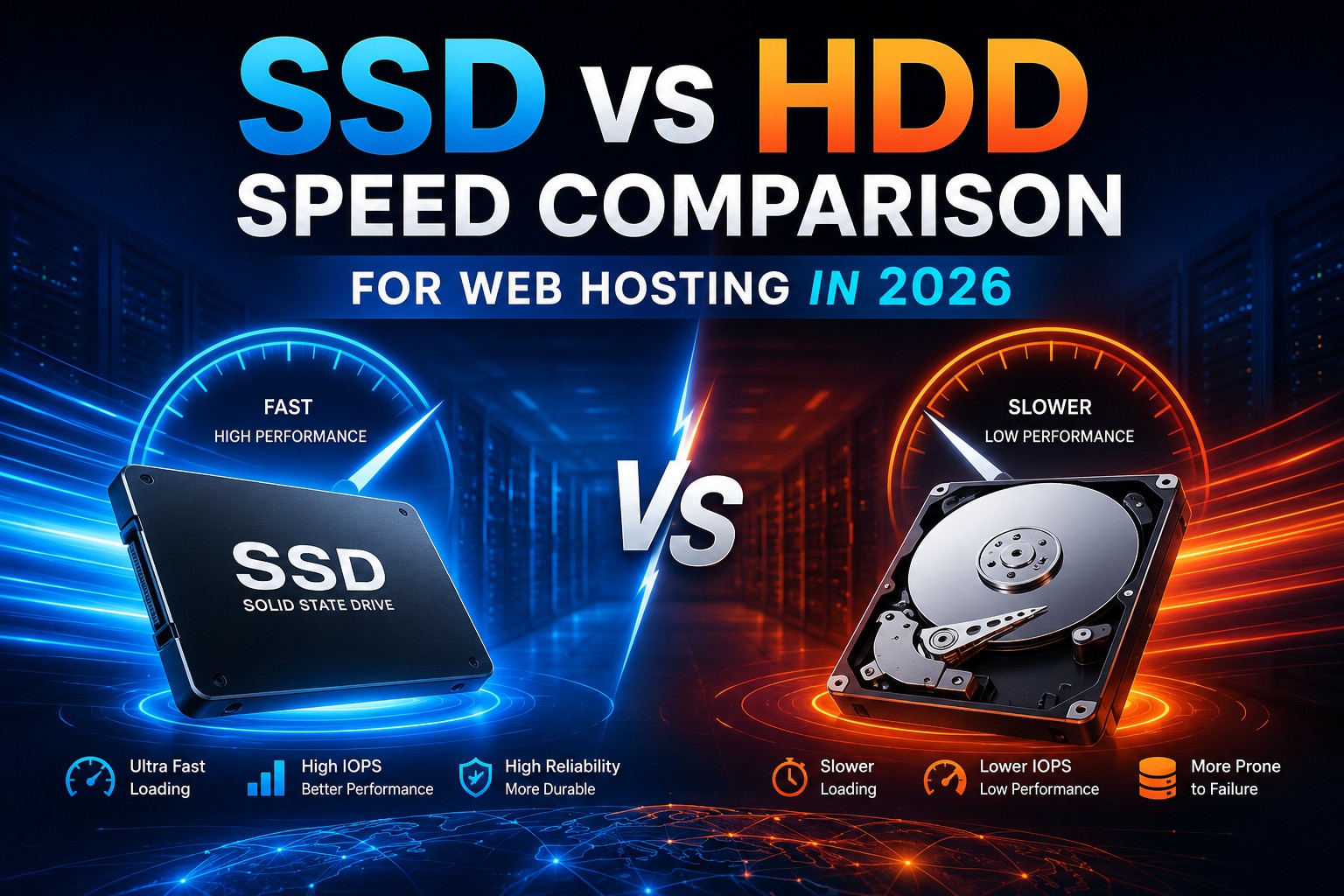
SSD vs HDD Speed Comparison for Web Hosting in 2026
- By Anis Ur Rahman
- 06 Jan, 2026
Last updated: 28 July 2026 | Read Time: 8 Minutes
Why Storage Speed Is the Real Hosting Bottleneck
When a website feels slow, most people blame the CPU or the bandwidth. In reality, storage speed is often the real bottleneck in web hosting.
Every page load pulls files, images, scripts, and database records from disk. If disk access is slow, everything else waits.
SSD (Solid-State Drive) and HDD (Hard Disk Drive) handle this job very differently. That difference directly affects server performance, latency, and SEO results.
One-line takeaway (featured snippet):
SSD hosting is faster than HDD because it reduces latency, disk access time, and server response delays. If speed matters to you—and in 2026, it always does—this comparison will help you choose wisely.
How Hosting Storage Works (SSD vs HDD at System Level)
To understand performance, we need to look under the hood.
HDD Architecture (Mechanical Limitation)
An HDD works like an old record player.
It has:
Spinning magnetic platters
A physical read/write head
Moving parts that must find data before reading it
Each request waits for:
The platter to spin
The head to move into position
This delay is called seek time, and it happens on every request.
Mechanical movement = unavoidable delay.
SSD Architecture (Solid-State Advantage)
An SSD works more like memory than a disk.
It uses:
NAND flash memory
Electronic access instead of moving parts
Parallel data channels
There is no waiting for anything to spin or move. Data is accessed instantly. SSD is faster than HDD because it accesses data electronically, while HDD relies on mechanical movement.
Explore More: SSD Storage vs HDD Hosting in 2026
Disk Access Time: The Core Speed Difference
Disk access time is the time it takes to locate and retrieve data. This is the single biggest speed difference between SSD and HDD hosting.
HDD vs SSD Access Time
HDD: 5–15 milliseconds
SSD: 0.02–0.1 milliseconds (microseconds)
That gap looks small on paper. But your site makes thousands of disk requests per page load.
Why This Matters for Hosting
Faster disk access means:
Faster file loading
Faster PHP execution
Faster database reads
Lower server response time
Why is SSD faster than HDD?
SSD is faster because it accesses data electronically with no moving parts, while HDD must physically move components to read data.
Summary:
SSD = microseconds
HDD = milliseconds
Multiply that difference by thousands of requests
Latency in Web Hosting: What’s Acceptable in 2026?
Latency is the delay between a request and a response. In hosting, storage latency directly affects how quickly your server reacts.
SSD vs HDD Latency
HDD latency stacks up during peak traffic
SSD latency stays low even under load
Acceptable Hosting Latency Benchmarks (2026)
Excellent: under 100ms
Average: 100–300ms
Poor: over 300ms
Most HDD-based hosting struggles to stay below 200ms consistently. SSD hosting makes sub-100ms latency achievable.
Clear numbers matter.
Search engines and users both notice delays.
Learn More: SSD Hosting Cost vs HDD Hosting in 2026
TTFB (Time to First Byte): SSD’s Hidden SEO Advantage

TTFB measures how long your server takes to send the first byte of data.
It includes:
Server processing time
Database queries
Disk access
How Storage Impacts TTFB
When storage is slow:
PHP scripts wait for files
Databases wait for indexes
The server stalls
SSD storage removes much of that waiting.
Why TTFB Matters for SEO
Google uses speed signals to evaluate user experience.
Lower TTFB helps:
Core Web Vitals performance
Crawl efficiency
Faster indexing
Sites on SSD hosting often see:
30–50% lower TTFB
Better crawl stability during traffic spikes
Explore More: Does SSD Hosting Improve SEO in 2026?
Page Load Speed: How Much Faster Is SSD Hosting Really?
Let’s talk about real-world numbers.
Typical Load Time Comparison
CMS Example
A WordPress site loading posts, menus, and widgets:
HDD waits on every query
SSD processes them in parallel
SSD hosting can be 5–10x faster than HDD hosting for dynamic websites. That speed difference feels instant to users.
Database Query Speed: Performance Under the Hood
Modern websites thrive or falter based on database speed.
Every action triggers:
SELECT queries
Index lookups
Cache rebuilds
Why SSD Improves Database Performance
SSD excels at:
Random read/write operations
Index access
High-frequency small queries
This matters for:
Content management systems
E-commerce stores
Membership platforms
On SSD hosting:
Queries return faster
Locks clear sooner
The CPU spends less time waiting
The result is smoother performance under load.
Concurrent Users: Can SSD Hosting Handle More Traffic?
Concurrent users refer to the maximum number of visitors your server can handle simultaneously.
The Real Bottleneck: I/O Wait
When many users arrive:
HDD queues disk requests
I/O wait spikes
Pages slow down
SSD minimizes I/O wait by handling multiple operations simultaneously.
Can SSD hosting handle more users?
Yes, SSD hosting can handle more concurrent users because it processes simultaneous read and write operations faster.
This matters during:
Sales events
Viral traffic
API-heavy workloads
SSD vs HDD: Speed Comparison Summary Table
When HDD Hosting Still Makes Sense (Edge Cases)
HDD hosting is not dead. It just has a narrower role.
HDD still works well for:
Backup storage
Archive websites
Very low-traffic static pages
If speed, SEO, or scalability matters, HDD is rarely the right choice.
Final Verdict: SSD vs HDD Speed Comparison for Web Hosting in 2026?
Let’s be clear.
For most websites in 2026:
SSD is faster
SSD scales better
SSD improves SEO signals
Choose SSD hosting if you care about:
Speed
User experience
Search visibility
For speed, SEO, and scalability, Best SSD hosting is the better choice over HDD in 2026.
FAQ About SSD vs HDD Speed Comparison for Web Hosting
Why is SSD faster than HDD?
SSD is faster because it accesses data electronically with no moving parts, while HDD relies on mechanical motion that causes delays.
What is acceptable latency for hosting?
In 2026, excellent hosting latency is under 100ms, average is 100–300ms, and poor is above 300ms.
How does TTFB affect SEO?
Lower TTFB improves Core Web Vitals, helps search engines crawl faster, and improves user experience.
Does SSD improve database performance?
Yes. SSD improves database performance by speeding up read/write operations, index access, and concurrent queries.
Can SSD hosting handle more users?
Yes. SSD hosting supports more concurrent users by reducing I/O wait and processing requests faster.
Read Our Relevant Guide:
NVMe SSD vs SATA SSD Hosting in 2026

Author By
Anis Ur Rahman
Anis Ur Rahman writes domain and web hosting–related articles on behalf of Ummah Host BD. He works with domain name selection, web hosting, BDIX hosting, and website performance, and creates informational guides based on practical experience to help users make informed decisions. His writing focuses on providing reliable, easy-to-understand, and decision-supportive content.
Search Blog
Categories
- Problem Solving 3
- RDP Hosting 4
- SMS Service 17
- IP Number 11
- Reseller Hosting 5
- Promo Offer 2
- Achieve 3
- SSD Hosting 5
- cPanel Hosting 7
- BDIX Hosting 7
- Email Hosting 4
- Dedicated Server 7
- User Guide 0
- Security 4
- Online security 6
- Business 5
- SEO 3
- VPS Hosting service 32
- Manage Hosting 1
- domain hosting service 29
- Domain 1
- Hosting 40