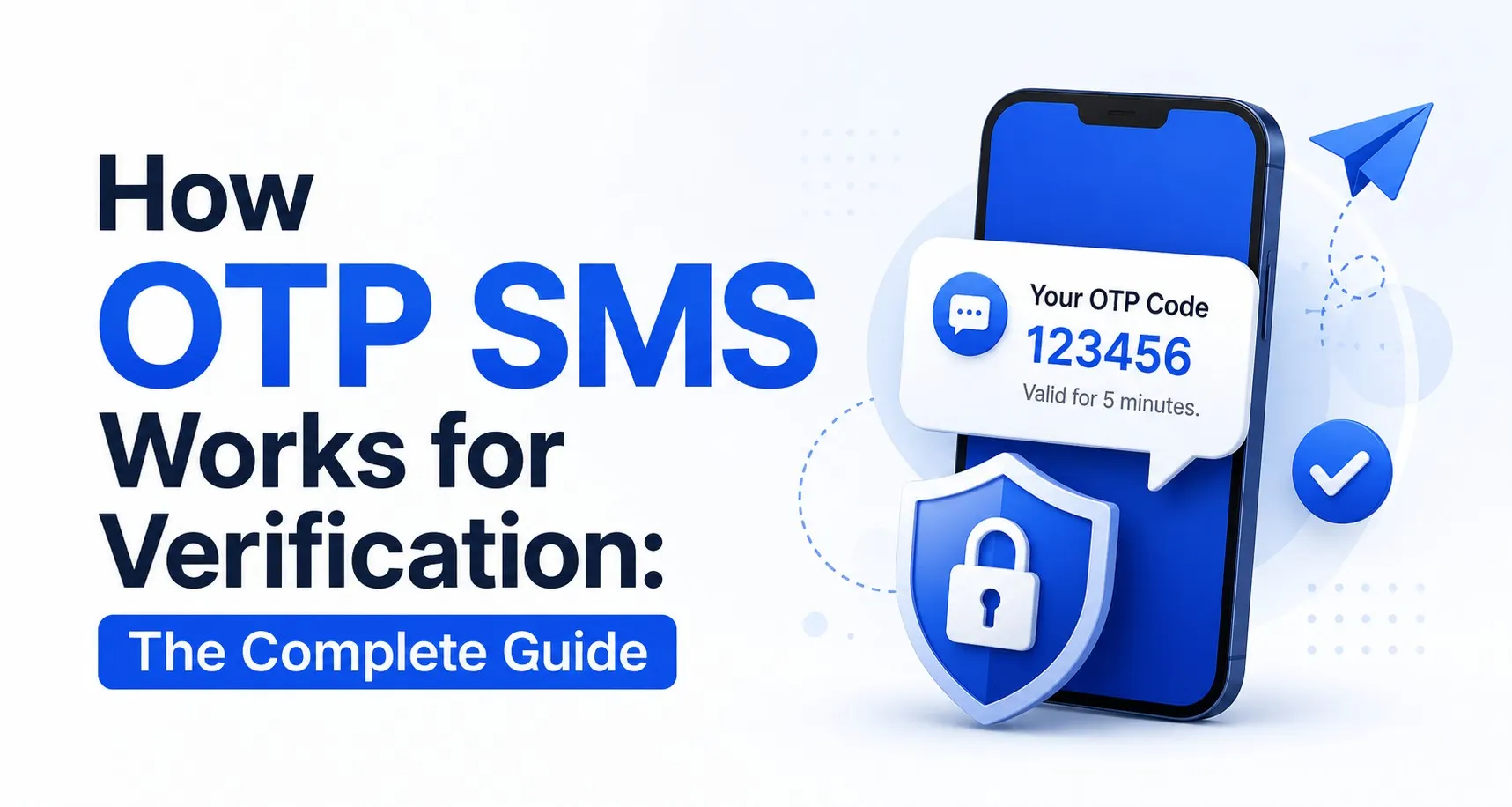
How OTP SMS Works for Verification: The Complete Guide
- By Anis Ur Rahman
- 24 May, 2026
What Is OTP SMS Verification?
You've seen it a hundred times. You log in to your bank. A text message arrives within seconds. It contains a six-digit code. You enter it. You're in.
That process is OTP SMS verification — and it's one of the most widely used security systems on the internet today. OTP stands for One-Time Password. It's a temporary numeric code sent to your phone via SMS. The code is valid for a short window — usually 30 to 120 seconds — and it can only be used once.
Think of it as a temporary security key. Once it's used or expires, it can no longer be used again.
How Does OTP SMS Work for Verification? (Step by Step)
Here's the exact flow of an OTP authentication system, broken down simply:
Step 1 — You request access.
The user submits their account credentials through the website or mobile app.
Step 2 — The system generates a code.
The server creates a unique, time-sensitive numeric code using an algorithm (typically TOTP or HOTP — more on that below).
Step 3 — The code is sent to your phone.
The platform uses an SMS gateway provider to deliver the OTP to your registered mobile number.
Step 4 — You enter the code.
You type the code into the login screen or verification field.
Step 5 — The system validates it.
The server checks if the code matches, hasn't expired, and hasn't been used before. If all three pass, you're authenticated.
Step 6 — The code expires.
Whether you use it or not, the code becomes invalid after the time window closes. That's the full loop. Simple, fast, and surprisingly effective.
Explore More: How SMS Marketing Works for Businesses in 2026
Why Is OTP Verification Important?
Passwords alone aren't enough anymore. Consider this: according to Verizon's 2024 Data Breach Investigations Report, over 80% of hacking-related breaches involved stolen or weak credentials.
A password can be guessed, phished, or leaked in a data breach. But an OTP? It's gone before an attacker can act.
OTP SMS adds a second layer of identity verification. Even if a hacker has your password, they don't have your phone. That's the core principle of two-factor authentication (2FA.
Here's why businesses rely on it:
It reduces account takeover fraud significantly
Frictionless — most users already know how it works
Requires no app download — just a working phone number
Builds user trust — customers feel safer when they see active security
What Is OTP Authentication? (The Technical Layer)
There are two main algorithms behind OTP generation:
1. TOTP — Time-Based One-Time Password
Defined by RFC 6238
The code changes every 30 seconds
Used by Google Authenticator and most modern platforms
Even if intercepted, the code is useless after expiry
2. HOTP — HMAC-Based One-Time Password
Defined by RFC 4226
Code changes based on a counter, not time
More common in hardware tokens
For SMS-based OTP systems, TOTP is the dominant standard. The server and your device share a secret key. A new code is derived from that key + the current timestamp. It's mathematically elegant.
Learn More: What Is Masking SMS Service in 2026
Is OTP SMS Secure?
Here's where you need an honest answer — not a sales pitch. Yes, OTP SMS is far more secure than a password alone, but it's not perfect. There are known attack vectors:
The nuanced truth: For the average user logging into an e-commerce site or banking app, OTP SMS provides excellent protection. The risks above are real — but they typically target high-value accounts with significant resources behind the attack.
For ultra-sensitive access (government systems, financial institutions handling large transactions), app-based authenticators or hardware tokens offer stronger protection. But for 95% of use cases? OTP SMS is secure, practical, and the right call.
Why Do Websites Use OTP SMS?
Three reasons dominate:
1. Universality
Every mobile phone can receive an SMS. You don't need a smartphone. You don't need an app. You don't need internet access. This makes OTP SMS accessible to every demographic.
2. Regulatory Compliance
Industries like banking, healthcare, and e-commerce face regulations (PCI-DSS, GDPR, RBI guidelines) that require multi-factor authentication. SMS OTP is an accepted, auditable compliance mechanism.
3. Conversion & Trust
Counterintuitively, OTP verification increases conversion rates for sensitive actions. A 2022 study by Twilio found that users who complete SMS verification during onboarding show 30% higher retention compared to those who skip it. Security signals trust. Trust drives engagement.
What Makes a Secure OTP SMS Service?
Not all SMS OTP providers are equal. Here's what separates a solid system from a vulnerable one:
Short expiry windows — 60–90 seconds maximum
Rate limiting — block brute force attempts on code entry
Single-use enforcement — codes invalidated immediately after use
Delivery redundancy — fallback routes if the primary SMS carrier fails
Audit logging — every OTP event is timestamped and logged
Enterprise platforms like Twilio, Rendcpanel, Vonage (formerly Nexmo), MSG91, and Sinch offer these capabilities at scale. For local providers in South Asia and Southeast Asia, MSG91 and Route Mobile are strong regional choices with compliance-ready infrastructure.
Get More: Best OTP SMS Service Bangladesh for Verification
Two-Factor Authentication SMS vs. Other 2FA Methods
For most consumer-facing applications, SMS OTP hits the sweet spot of security + accessibility + adoption rate.
Who Controls the OTP Ecosystem?
The OTP SMS space involves several key entities worth knowing:
IETF — Maintains the RFC standards (RFC 6238, RFC 4226) that define OTP algorithms
GSMA — The global body governing SMS protocols and telecom security standards
NIST (National Institute of Standards and Technology) — Publishes digital identity guidelines (SP 800-63B) that inform how OTPs should be implemented
Twilio, Vonage, Sinch — Leading cloud communication platforms powering OTP delivery globally
These aren't just background players. Their standards and infrastructure shape how every OTP you receive is generated and delivered.
Frequently Asked Questions
Q: How does OTP SMS work?
A: When you log in or verify your identity, a server generates a temporary numeric code and sends it to your phone via SMS. You enter the code to prove you have access to the registered phone number. The code expires in 30–120 seconds and can only be used once.
Q: Why is OTP verification important?
A: Passwords can be stolen, guessed, or leaked. OTP adds a second layer of verification that requires physical access to your phone. Even if someone has your password, they can't get in without your OTP.
Q: What is OTP authentication?
A: OTP authentication is a security method where a one-time, time-sensitive code is used to verify identity. It's typically used as part of two-factor authentication (2FA), adding a second checkpoint beyond just a password.
Q: Is OTP SMS secure?
A: Yes — for most use cases. OTP SMS is significantly more secure than passwords alone. It has some vulnerabilities (like SIM swapping), but these are rare and primarily target high-value accounts. For everyday consumer apps and business platforms, OTP SMS is a solid, widely accepted security layer.
Q: Why do websites use OTP SMS?
A: Websites use OTP SMS because it's universally accessible, easy to implement, compliant with security regulations, and proven to reduce account fraud. It also builds user trust without creating significant friction in the login experience.
The Bottom Line
OTP SMS verification isn't going away. It's practical, universal, and battle-tested at billions of touchpoints daily — from WhatsApp sign-ups in Dhaka to PayPal logins in London.
Is it perfect? No. But it's one of the most effective tools available for protecting digital identity at scale. If you're building a product, implement OTP SMS for account verification, login, and sensitive transactions. Choose a provider with rate limiting, short expiry windows, and delivery redundancy. Pair it with app-based 2FA for your most security-sensitive users.
That's not just best practice. That's the standard set by the best security teams in the world.
Learn More Relevant Guide 2026: What Is Sender ID in SMS Marketing?

Author By
Anis Ur Rahman
Anis Ur Rahman writes domain and web hosting–related articles on behalf of Ummah Host BD. He works with domain name selection, web hosting, BDIX hosting, and website performance, and creates informational guides based on practical experience to help users make informed decisions. His writing focuses on providing reliable, easy-to-understand, and decision-supportive content.
Search Blog
Categories
- Problem Solving 3
- RDP Hosting 4
- SMS Service 17
- IP Number 11
- Reseller Hosting 5
- Promo Offer 2
- Achieve 3
- SSD Hosting 5
- cPanel Hosting 7
- BDIX Hosting 7
- Email Hosting 4
- Dedicated Server 7
- User Guide 0
- Security 4
- Online security 6
- Business 5
- SEO 3
- VPS Hosting service 32
- Manage Hosting 1
- domain hosting service 29
- Domain 1
- Hosting 40