Cloud Call Center vs Traditional Call Center: Which One Actually Works?
- By Anis Ur Rahman
- 16 Apr, 2026
Published: 25 August, 2026 | Reading Time: 10 Minutes
If you're still running customer calls from a single office, you might be falling behind. The way businesses handle customer service has shifted fast. Cloud-based call centers are replacing old hardware setups — and the gap is growing every year.
So let's get straight to it.
What's the real difference between a Cloud Call Center and a Traditional Call Center?
Which system is better?
Can remote call centers actually work in Bangladesh?
What Is a Cloud Call Center?
A cloud call center runs entirely over the internet. Agents can work from anywhere — home, a co-working space, a satellite office. No servers. No desk phones bolted to a wall. Everything lives in a browser. Calls, chats, customer data, and analytics — all managed through one platform. Think of it like your entire call operation fitting inside a laptop.
Popular platforms include Amazon Connect, Talkdesk, Five9, and Genesys Cloud. These tools handle call routing, recording, CRM integration, and reporting — without a single piece of on-site hardware.
What Is a Traditional Call Center?
A traditional call center is built on physical infrastructure that means on-premise servers, PBX hardware, fixed desk phones, and a dedicated IT team to keep it all running. Every agent works from one building. Every system update requires manual intervention. Every new hire needs a physical workstation.
This model served businesses well for decades. Large banks, telecom companies, and government agencies still rely on it, but in 2026, it carries serious operational and financial disadvantages for most businesses.
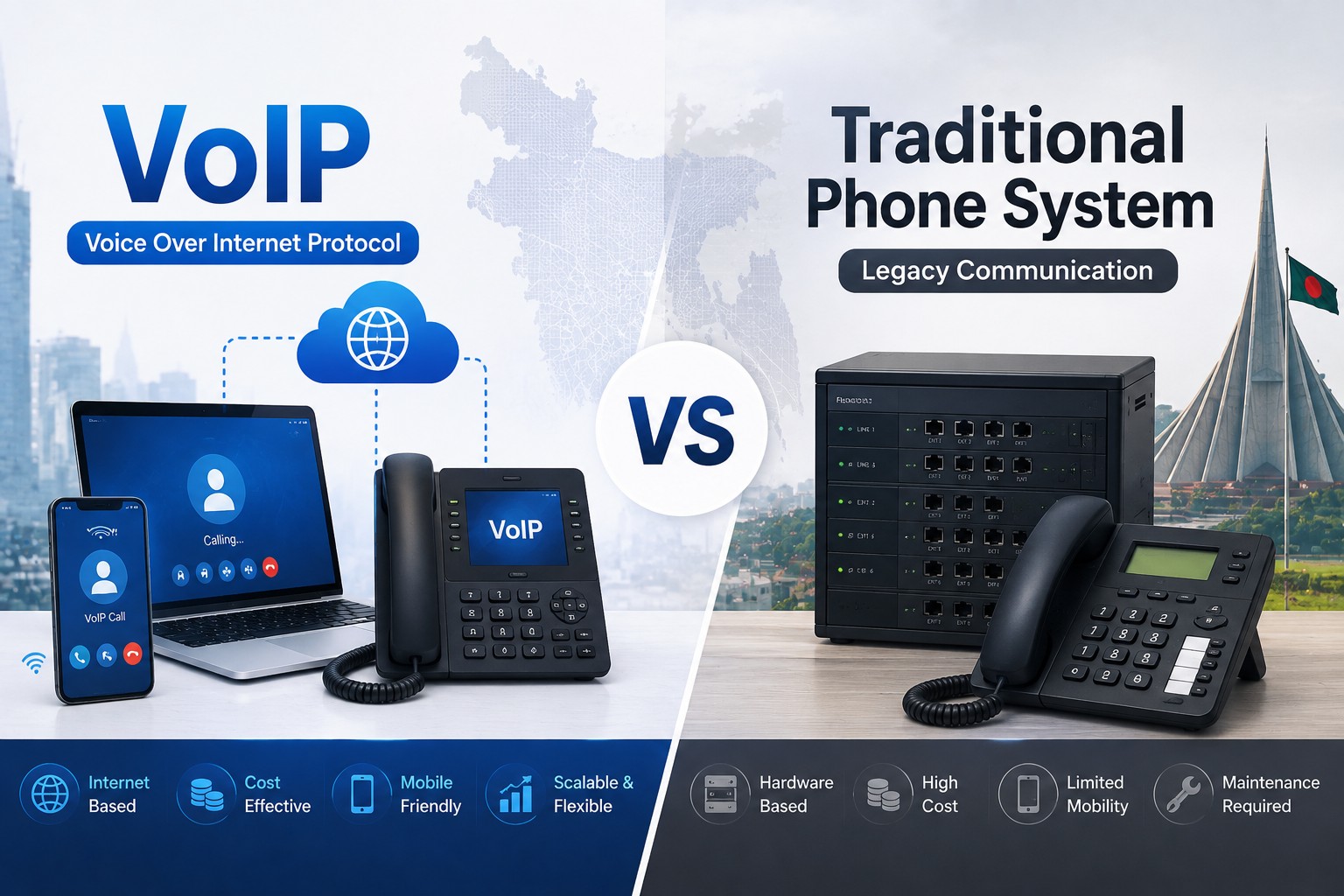
Compare in detail: VoIP vs Traditional Phone System in Bangladesh
The Core Differences: Side by Side
Here's where things get clear fast.
Setup cost:
Cloud systems require no hardware investment — just a software subscription.
Traditional setups demand large upfront capital for servers, PBX equipment, and installation.
Deployment time:
A cloud call center can go live in days.
Traditional systems take weeks to months.
Scalability:
Need 20 more agents next week?
On cloud, that's a few clicks.
On traditional infrastructure, it means buying more hardware and waiting.
Remote work:
Cloud platforms are built for distributed teams.
Traditional systems are not — agents are tied to physical desks.
IT maintenance:
Cloud vendors handle updates, security patches, and uptime.
Traditional setups need in-house IT staff.
Analytics:
Cloud platforms deliver real-time dashboards — call volume, wait times, agent performance.
Traditional systems produce delayed, manual reports.
The verdict is straightforward for most businesses: cloud wins on every practical dimension.
Where Traditional Systems Still Hold Ground
To be fair, traditional setups aren't obsolete everywhere. They still make sense in industries with strict data sovereignty laws — banking, defense, certain government sectors. They work for organizations that already have large infrastructure investments paid off.
And in regions where internet connectivity is genuinely unreliable, having everything on-premise removes one major risk, but these are exceptions, not the rule.
Can Call Centers Actually Work Remotely?
Yes. And the data backs it up. A landmark study by Stanford economist Nicholas Bloom tracked remote call center agents over nine months. The result?
Remote agents were 13% more productive than their office-based counterparts. They handled more calls per hour, took fewer sick days, and reported higher job satisfaction.
For businesses in Bangladesh, remote call center operations offer specific advantages:
Access to talent beyond Dhaka — Chittagong, Sylhet, Rajshahi
Lower overhead costs without large city-center office space
Business continuity during flooding, hartals, or Dhaka's notorious traffic gridlock
Agents performing in comfortable, distraction-managed environments
The requirements are simple: a reliable internet connection, a cloud platform, and proper quality monitoring that's genuinely it.
What to Look for in a Remote Call Center Solution for Bangladesh
Not all platforms are equal in the local context. Here's what actually matters:
Internet reliability:
Build a backup plan. SIM-based mobile internet as a fallback keeps agents online during fiber outages — a real issue outside major cities.
Bangla language support:
Customers navigate IVR menus better in their native language. Platforms with Bangla IVR capability directly improve call completion rates.
Compliance:
If you handle financial data, review Bangladesh Bank's data localization guidelines before choosing a foreign-hosted platform.
CRM integration:
Your call platform should connect cleanly with your existing customer data system — whether that's Salesforce, HubSpot, or a local ERP.
Platforms worth evaluating:
Freshdesk Contact Center — strong for SMBs, easy setup
Talkdesk and Five9 — enterprise-level features
SSL Wireless and Grameenphone Enterprise — locally hosted with Bangladesh-specific support
Explore More: How to Set Up a VoIP System in Bangladesh
How to Switch: A Practical Roadmap
Moving from traditional to cloud doesn't have to disrupt your operations.
Step 1 — Audit what you have
Document every phone line, workflow, and hardware dependency before you touch anything.
Step 2 — Define your requirements
How many agents?
Which channels — voice, chat, email?
What's your daily call volume?
Do you need CRM integration?
Step 3 — Pick your platform
Match the tool to your actual scale. A 10-agent team doesn't need enterprise pricing.
Step 4 — Run a 30-day pilot
Put 5–10 agents on the new system while your old setup stays running. Compare performance directly.
Step 5 — Train your team
Cloud platforms are intuitive, but structured onboarding reduces errors and builds confidence.
Step 6 — Go live and track performance
Monitor call abandonment rate, first-call resolution, and agent utilization from day one.
The Bottom Line Of Cloud Call Center vs Traditional Call Center
Cloud call centers aren't an emerging trend anymore. They're the operating standard.
If your business is still running on traditional infrastructure, you're carrying a structural disadvantage — in cost, flexibility, and talent access. The question is no longer whether to switch. It's how fast you can move.
For Bangladesh specifically, the opportunity is real. You can build a scalable, remote-capable customer service operation without the capital investment that made this impossible for mid-sized businesses a decade ago. The technology exists. Local support infrastructure is improving. What's left is execution.
Explore More: VoIP vs Traditional Phone System in Bangladesh
Frequently Asked Questions
What is the difference between a cloud call center and a traditional call center?
A cloud call center runs over the internet — no hardware, no fixed location. A traditional call center uses on-premise servers and fixed phones. Cloud is cheaper, faster, and remote-friendly.
Which call center system is better?
Cloud is better for most businesses. It's low-cost, scalable, and supports remote agents. Traditional only suits enterprises with strict compliance needs.
Can call centers work remotely?
Yes. Stanford research proved remote agents are 13% more productive. A cloud platform and stable internet are the only requirements.
What are the best remote call center solutions for Bangladesh?
Freshdesk for SMBs. Talkdesk and Five9 for enterprise. SSL Wireless and Grameenphone Enterprise for local Bangla IVR support.
How quickly can a cloud call center be set up?
Basic setup: 24–72 hours. Full deployment with CRM integration: one to two weeks.
Is a cloud call center secure?
Yes. Top platforms hold SOC 2 and ISO 27001 certifications — often more secure than on-premise setups.
Learn Relevant Guide in 2026: Best IP Number Providers in Bangladesh

Author By
Anis Ur Rahman
Anis Ur Rahman writes domain and web hosting–related articles on behalf of Ummah Host BD. He works with domain name selection, web hosting, BDIX hosting, and website performance, and creates informational guides based on practical experience to help users make informed decisions. His writing focuses on providing reliable, easy-to-understand, and decision-supportive content.
Search Blog
Categories
- Problem Solving 3
- RDP Hosting 4
- SMS Service 17
- IP Number 11
- Reseller Hosting 5
- Promo Offer 2
- Achieve 3
- SSD Hosting 5
- cPanel Hosting 7
- BDIX Hosting 7
- Email Hosting 4
- Dedicated Server 7
- User Guide 0
- Security 4
- Online security 6
- Business 5
- SEO 3
- VPS Hosting service 33
- Manage Hosting 1
- domain hosting service 29
- Domain 1
- Hosting 43