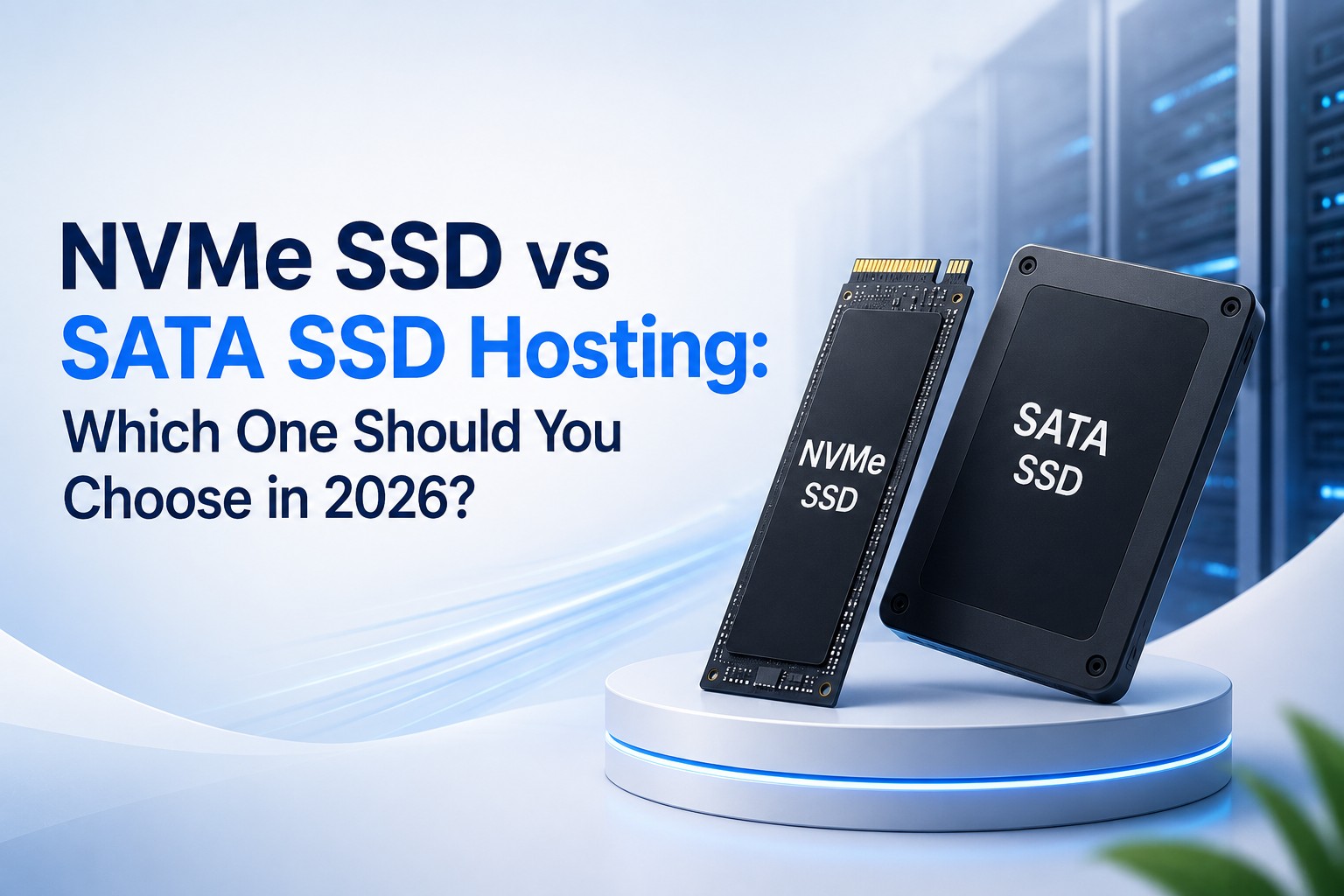
NVMe SSD vs SATA SSD Hosting: Which One Should You Choose in 2026?
- By Anis Ur Rahman
- 16 Jan, 2026
Last Updated: 30 July 2026 | Read Time: 5 Minutes
Choosing a hosting plan in 2026 is no longer just about disk space and price. Speed, scalability, and user experience now directly affect your traffic, conversions, and even Google rankings.
That’s why many website owners are asking a simple but critical question: NVMe SSD vs SATA SSD Hosting — which one should I choose?
If you’re confused, you’re not alone. Hosting providers often promote “ultra-fast NVMe” or “budget SSD hosting,” but rarely explain who actually needs what. This article fixes that problem.
We’ll walk through:
What NVMe and SATA SSD hosting really mean
How they affect speed, SEO, and growth
Real performance data and a local case study
Clear recommendations based on your use case
Why Storage Type Matters More Than Ever
Let’s start with the why.
In 2026, websites are doing more work than ever before:
Dynamic content loading
Database-heavy CMS like WordPress
WooCommerce, LMS, CRM, automation tools
API calls, analytics scripts, AI widgets
Every one of these actions requires storage access.
Your server doesn’t just store files—it constantly:
Reads data
Writes logs
Fetches database queries
Serves content to users
If storage is slow, everything slows down. This is why the storage layer has become a major performance bottleneck—and why the NVMe vs SATA discussion matters.
You Can Explore More: Best Hosting Storage for WordPress, eCommerce & High-Traffic Websites
Understanding SSD Hosting
Before comparing, let’s set a baseline.
What Is SSD Hosting?
SSD (Solid State Drive) hosting means your website data is stored on flash memory instead of spinning hard disks (HDD).
Compared to HDD:
SSD is faster
More reliable
Uses less power
Has lower failure rates
But not all SSDs are the same. That’s where NVMe and SATA come in.
What Is NVMe SSD Hosting?
NVMe stands for Non-Volatile Memory Express. It’s not just a type of SSD—it’s a modern communication protocol designed specifically for high-speed data transfer.
The Key Difference
NVMe SSDs communicate directly with the CPU using the PCIe interface. This removes many of the limitations older storage systems have.
Simple Analogy
Imagine a restaurant:
SATA SSD = one waiter taking orders
NVMe SSD = automated ordering system
Both work—but one scales effortlessly.
Core Advantages of NVMe SSD Hosting
Extremely high read/write speed
Very low latency
Handles thousands of simultaneous requests
Ideal for modern, dynamic websites
This is why NVMe is widely used in:
Cloud infrastructure
Enterprise servers
High-performance VPS hosting
What Is SATA SSD Hosting?
SATA SSD hosting uses SSDs connected through the SATA interface, which was originally designed for hard drives.
While SATA SSDs are much faster than HDDs, they have a speed ceiling.
Strengths of SATA SSD Hosting
Affordable
Reliable
Good upgrade from HDD
Easy to maintain
Limitations
Lower bandwidth
Higher latency than NVMe
Performance drops under heavy load
Still, SATA SSD hosting isn’t “bad.” It’s just older technology.
Real Performance Difference (Numbers That Matter)
Let’s look at practical speed differences.
Typical Speed Ranges
SATA SSD: ~450–550 MB/s
NVMe SSD: 3,000–7,000 MB/s
That’s not a small improvement—it’s*multiple times faster.
Why Is NVMe Faster Than SATA?
Because:
NVMe uses PCIe lanes
SATA is limited by legacy architecture
NVMe supports parallel data queues
In real terms, this means:
Faster page loads
Faster database queries
Better handling of traffic spikes
Explore More: SSD vs HDD Speed Comparison for Web Hosting in 2026
Hosting Performance and SEO Impact
Google doesn’t rank “fast servers”—it ranks good user experiences.
Speed influences:
Bounce rate
Time on site
Conversion rate
And indirectly:
Crawl efficiency
Indexing behavior
A faster server helps your content perform better.
This is where NVMe SSD vs SATA SSD Hosting becomes an SEO decision, not just a technical one.
Learn Full Guide: Does SSD Hosting Improve SEO in 2026
Comparison Table: NVMe vs SATA SSD Hosting
Check More: SSD Hosting Cost vs HDD Hosting in 2026
Which Hosting Type Is Best for You?
Let’s get specific.
NVMe SSD Hosting Is Best If You:
Run WooCommerce or eCommerce
Manage multiple client websites
Use automation tools or APIs
Expect traffic growth
Care about long-term SEO
SATA SSD Hosting Is Best If You:
Are starting a personal blog
Have limited traffic
Need low monthly cost
Run a simple static website
This is not about good vs bad.
It’s about matching technology to goals.
Real Case Study: Local Hosting Upgrade
A small digital agency in Bangladesh migrated a client site from SATA SSD hosting to NVMe SSD hosting in late 2025.
Before Migration

Homepage load time: 3.9 seconds
Time to First Byte: ~920 ms
Mobile bounce rate: 62%
After Migration

Homepage load time: 1.5 seconds
Time to First Byte: ~210 ms
Mobile bounce rate: 41%
No design changes. No content updates. Only storage upgrade.
This kind of improvement directly affects:
User trust
SEO signals
Conversion rates
Cost vs Value: The Real Question
Yes, NVMe hosting costs more.
But ask yourself:
What does slow performance cost you?
Slow sites lead to:
Lost visitors
Lower rankings
Fewer conversions
For business websites, NVMe often pays for itself but for hobby sites, SATA SSD may still be enough.
Scalability and Future-Proofing
Websites rarely stay small forever. Traffic grows. Features expand. Expectations rise.
NVMe hosting is better prepared for:
Traffic spikes
AI-powered tools
Real-time data processing
Future CMS updates
If you’re planning, NVMe is a safer long-term investment.
How to Choose the Right SSD Hosting
Step 1: Define Your Website Type
Blog, business, store, SaaS, portfolio
Step 2: Estimate Traffic
Under 5k/month → SATA SSD
Over 10k/month → NVMe SSD
Step 3: Consider Growth
Planning to scale? Choose NVMe early
Step 4: Balance Budget vs ROI
Cheap hosting isn’t cheap if it limits growth
Expert Recommendation
Here’s the honest summary:
Beginners → SATA SSD is fine
Professionals → NVMe SSD is smarter
Businesses → NVMe is strongly recommended
For most modern websites, NVMe SSD vs SATA SSD Hosting is no longer optional—it’s strategic.
Get More: Fast & Optimized Hosting for Bangladesh in 2026
Frequently Asked Questions
Is NVMe SSD hosting overkill for beginners?
Not overkill, but not required. SATA SSD works well for small sites.
Can SATA SSD hosting still rank on Google?
Yes. Content quality matters most. Speed helps, but it’s not the only factor.
Does NVMe SSD improve WordPress performance?
Yes, especially for database-heavy WordPress sites.
Should I upgrade from SATA to NVMe?
If your site is growing or slowing down, upgrading is a smart move.
Final Thoughts
Choosing hosting isn’t about buzzwords. It’s about understanding your needs and planning for the future. If speed, SEO, and scalability matter to you, NVMe is the clear winner in 2026. If simplicity and budget are your priority, SATA SSD still has its place.

Author By
Anis Ur Rahman
Anis Ur Rahman writes domain and web hosting–related articles on behalf of Ummah Host BD. He works with domain name selection, web hosting, BDIX hosting, and website performance, and creates informational guides based on practical experience to help users make informed decisions. His writing focuses on providing reliable, easy-to-understand, and decision-supportive content.
Search Blog
Categories
- Problem Solving 3
- RDP Hosting 4
- SMS Service 17
- IP Number 11
- Reseller Hosting 5
- Promo Offer 2
- Achieve 3
- SSD Hosting 5
- cPanel Hosting 7
- BDIX Hosting 7
- Email Hosting 4
- Dedicated Server 7
- User Guide 0
- Security 5
- Online security 6
- Business 5
- SEO 3
- VPS Hosting service 33
- Manage Hosting 1
- domain hosting service 29
- Domain 1
- Hosting 43
Latest News
14 Oct, 2026