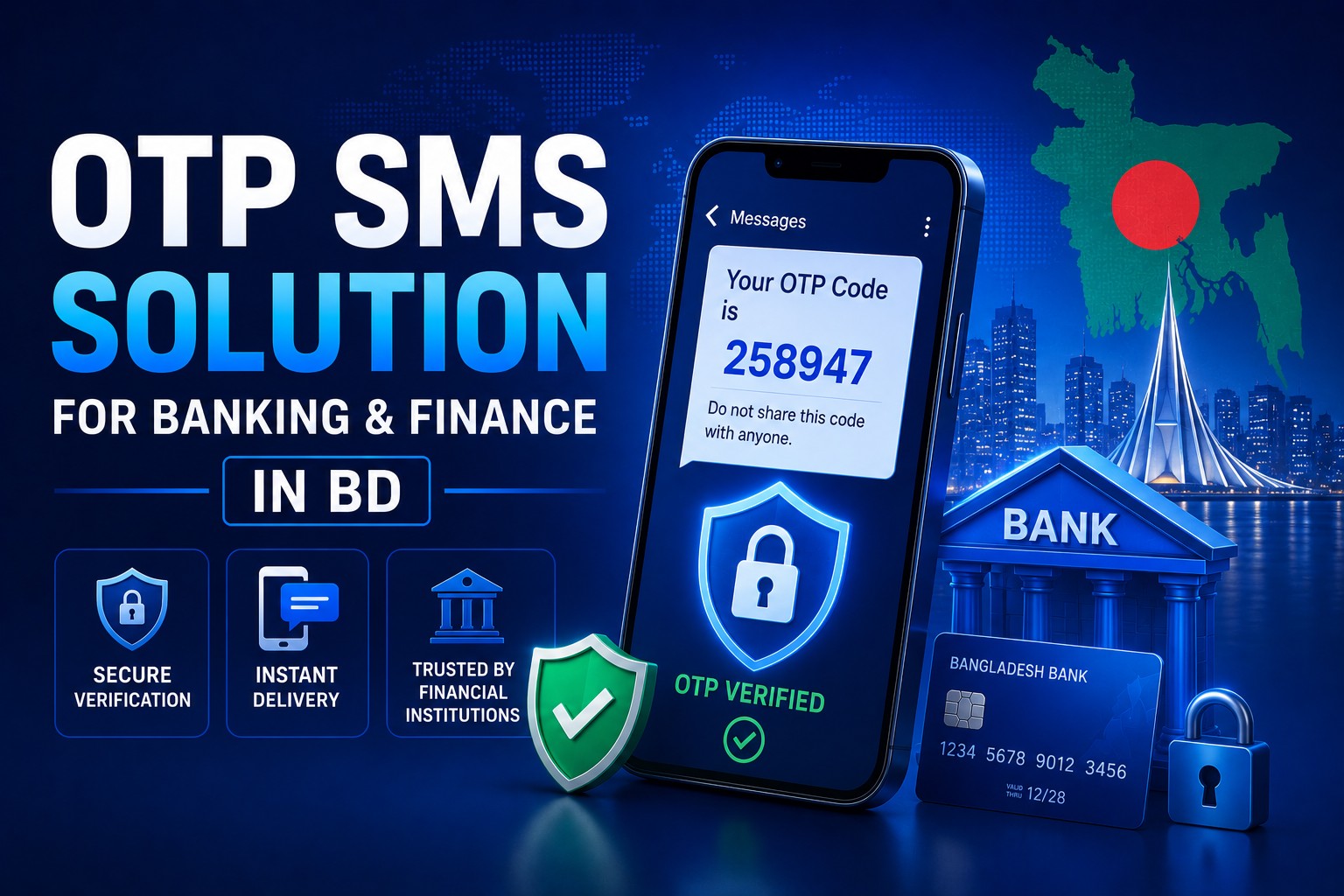
Best OTP SMS Solution for Banking & Finance in Bangladesh
- By Anis Ur Rahman
- 15 Jul, 2026
Every time you log in to your banking app or approve a payment, a six-digit code appears on your phone. That small text does a big job — it proves you're really you. This is banking OTP SMS in action, and it has become one of the most trusted security tools for protecting digital banking and financial transactions. In Bangladesh, banks, mobile financial services (MFS), fintech apps, and payment gateways rely on OTP SMS to verify users and secure financial transactions.
In this guide, you'll learn who uses OTP SMS in banking, how it actually works behind the scenes, and why it remains a core piece of financial security — along with where the industry is headed next.
Who Relies on OTP SMS in Banking and Finance?
OTP SMS isn't limited to traditional banks. It's baked into nearly every corner of financial services today.
Retail banks such as BRAC Bank, Dutch-Bangla Bank PLC, Islami Bank Bangladesh PLC, and Eastern Bank use OTP SMS to verify customer logins and approve financial transactions.
Mobile financial services (MFS) like bKash, Nagad, and Rocket rely on OTP SMS to secure account access and payment verification.
Fintech apps use OTP SMS to verify new account registrations, password resets, and digital payments.
Payment gateways use it to authorize online card and wallet transactions.
Lending, insurance, and investment platforms use OTP SMS to verify customer identity during applications and high-value transactions.
The reason is straightforward: SMS reaches customers quickly, works on nearly every mobile phone, and doesn't depend on an internet connection.
How Does Banking OTP SMS Actually Work?
The process feels instant to the customer, but a few steps happen behind the scenes every time.
You trigger an action — logging in, making a transfer, or resetting a password
The bank's system generates a one-time code, usually 4 to 6 digits
The code is sent via SMS to the phone number on file
You enter the code into the app or website
The system verifies it matches and expires it immediately after use (or after a short time window)
That last step matters. A good OTP is only valid once and only valid briefly — often just a few minutes. This limits the damage if a code is somehow intercepted.
Explore More: How OTP SMS Works for Verification in 2026
What is a Secure Banking OTP?
A secure banking OTP isn't just a random number sent by text. It typically includes several layers working together:
Time-limited codes that expire in minutes, not hours
One-time use only— the code can't be reused
Rate limiting to stop attackers from guessing codes repeatedly
Device and number binding, so a code sent to your phone can't easily be reused elsewhere
Fraud monitoring that detects unusual OTP activity, such as multiple code requests within a short period.
Think of it like a temporary digital key that expires automatically after a single use.
How Secure Transaction SMS Protects Banking Transactions
How Do Banks Verify Transactions?
Banks rarely rely on OTP alone. Instead, they combine it with other checks to build what's called layered, or multi-factor, authentication.
A typical transaction verification flow includes:
Your password or PIN
Your phone, which receives the OTP
Increasingly, biometrics like a fingerprint or face scan
Is this login from a new device or an unusual location?
Before approving a high-value transaction, the system performs multiple security checks before sending an OTP SMS for verification. If something looks off — a login from a new country, for example — the bank may block the OTP entirely or add extra verification steps. This layered approach is why a stolen password alone usually isn't enough for a criminal to move your money. They'd also need your phone.
Fintech SMS Verification: Speed Meets Security
Fintech platforms rely on OTP SMS because it enables fast user verification while meeting modern security and compliance requirements.
Fintech sms verification is commonly used for:
New account signups and identity checks (KYC)
Confirming payments between apps or wallets
Verifying password resets
Approving high-value trades or withdrawals
For a startup, this matters a lot. Building custom authentication systems is expensive and slow. Plugging into an SMS OTP API lets a fintech launch a secure product in weeks instead of months, while still meeting the baseline security expectations customers and regulators demand.
Banking SMS Alert System: Beyond OTPs
What Is a Banking SMS Alert?
Not every banking text is an OTP. Banks also send real-time alerts to keep customers informed about account activity—even when no action is required from the user.
A typical banking SMS alert system in Bangladesh includes:
Low balance notifications
Cash-out and payment confirmations from mobile financial services such as bKash and Nagad
ATM withdrawal alerts
Debit or credit card transaction notifications
Failed login attempt alerts
Bill payment and EMI due reminders
In Bangladesh, these alerts are widely used by banks and mobile financial service providers to help customers detect suspicious activity quickly and take immediate action if needed.
Is OTP SMS Secure for Banking? An Honest Answer
This is where the conversation gets more nuanced, and it's worth being upfront about it. For years, SMS OTP was the gold standard. It's still widely used and, for everyday logins and low-risk transactions, it remains a meaningful barrier against basic password theft — a stolen password alone usually isn't enough to get in.
But the security landscape has shifted. SMS messages can, in rare cases, be intercepted through techniques like SIM swapping, where a criminal tricks a carrier into transferring a victim's phone number to a new SIM card. This is why regulators in several countries have started pushing banks toward stronger methods for high-value actions.
Around the world, financial regulators are increasingly encouraging banks to combine SMS OTP with stronger authentication methods such as biometric verification, device recognition, fraud monitoring, and passkeys for high-risk financial transactions.
What this means in practice:
SMS OTP Service is still a reasonable, low-friction layer for everyday banking
It works best paired with fraud monitoring — rate limits, device checks, anomaly detection
For high-value transfers, many banks now add extra steps beyond a text code
The direction of travel is toward layered authentication, not SMS alone
The honest takeaway: OTP SMS isn't broken, but it's no longer treated as sufficient on its own for the biggest financial decisions. Smart banks use it as one layer in a stack, not the entire wall.
Getting Started: A Quick Checklist for OTP SMS in Banking
Before rolling out or reviewing your OTP SMS setup, check for:
Codes that expire within a few minutes
One-time use enforcement
Rate limiting to prevent brute-force attacks
Fraud monitoring and anomaly detection
SIM-swap detection
Real-time delivery reports
BTRC-compliant SMS provider
Branded Sender ID
Backup verification method for high-value transactions
Check More: Best OTP SMS Service Bangladesh for Verification
Frequently Asked Questions
Why do banks use OTP SMS?
Because nearly every customer has a phone that can receive a text instantly, making it a fast, low-cost way to confirm that the person completing a transaction is who they claim to be.
What is a secure banking OTP?
It's a one-time code that expires quickly, can only be used once, and is backed by fraud checks like rate limiting and device verification — not just a random number sent by text.
How do banks verify transactions?
Banks typically combine a password, an OTP sent to your phone, and behavioral or device signals, only approving a transaction when all the checks line up.
Is OTP SMS secure for banking?
It's a solid layer for everyday transactions, but not foolproof on its own — SIM swap fraud can bypass it, which is why regulators now push banks to add extra protection for high-value transfers.
What is a banking SMS alert?
It's a real-time text notifying you of account activity, like a large transaction or failed login, so you can act quickly if something looks wrong.
If you're building or upgrading a best OTP SMS solution for a bank, fintech platform, or mobile financial service in Bangladesh, start with secure OTP delivery, then strengthen it with fraud monitoring, device verification, and a BTRC-compliant SMS provider.
Learn More: Bulk SMS Service in Bangladesh for Business Marketing

Author By
Anis Ur Rahman
Anis Ur Rahman writes domain and web hosting–related articles on behalf of Ummah Host BD. He works with domain name selection, web hosting, BDIX hosting, and website performance, and creates informational guides based on practical experience to help users make informed decisions. His writing focuses on providing reliable, easy-to-understand, and decision-supportive content.
Search Blog
Categories
- Problem Solving 3
- RDP Hosting 4
- SMS Service 17
- IP Number 11
- Reseller Hosting 5
- Promo Offer 2
- Achieve 3
- SSD Hosting 5
- cPanel Hosting 7
- BDIX Hosting 7
- Email Hosting 4
- Dedicated Server 7
- User Guide 0
- Security 4
- Online security 6
- Business 5
- SEO 3
- VPS Hosting service 33
- Manage Hosting 1
- domain hosting service 29
- Domain 1
- Hosting 43