SMS API Service Bangladesh: Integrate & Automate SMS
- By Anis Ur Rahman
- 08 Jun, 2026
Your customer places an order, but they don't receive any confirmation, OTP, or update. As a result, they start wondering whether the order went through at all.
They leave — and they don't come back.
That's the cost of not having an SMS API integrated into your website. In Bangladesh, where SMS open rates hover near 98% and mobile penetration crosses 180 million subscribers, a missed text is a missed sale.
This guide shows you exactly what SMS API service is, how to integrate it with your website, and how to automate the whole thing — without overcomplicating it.
What Is SMS API Service?
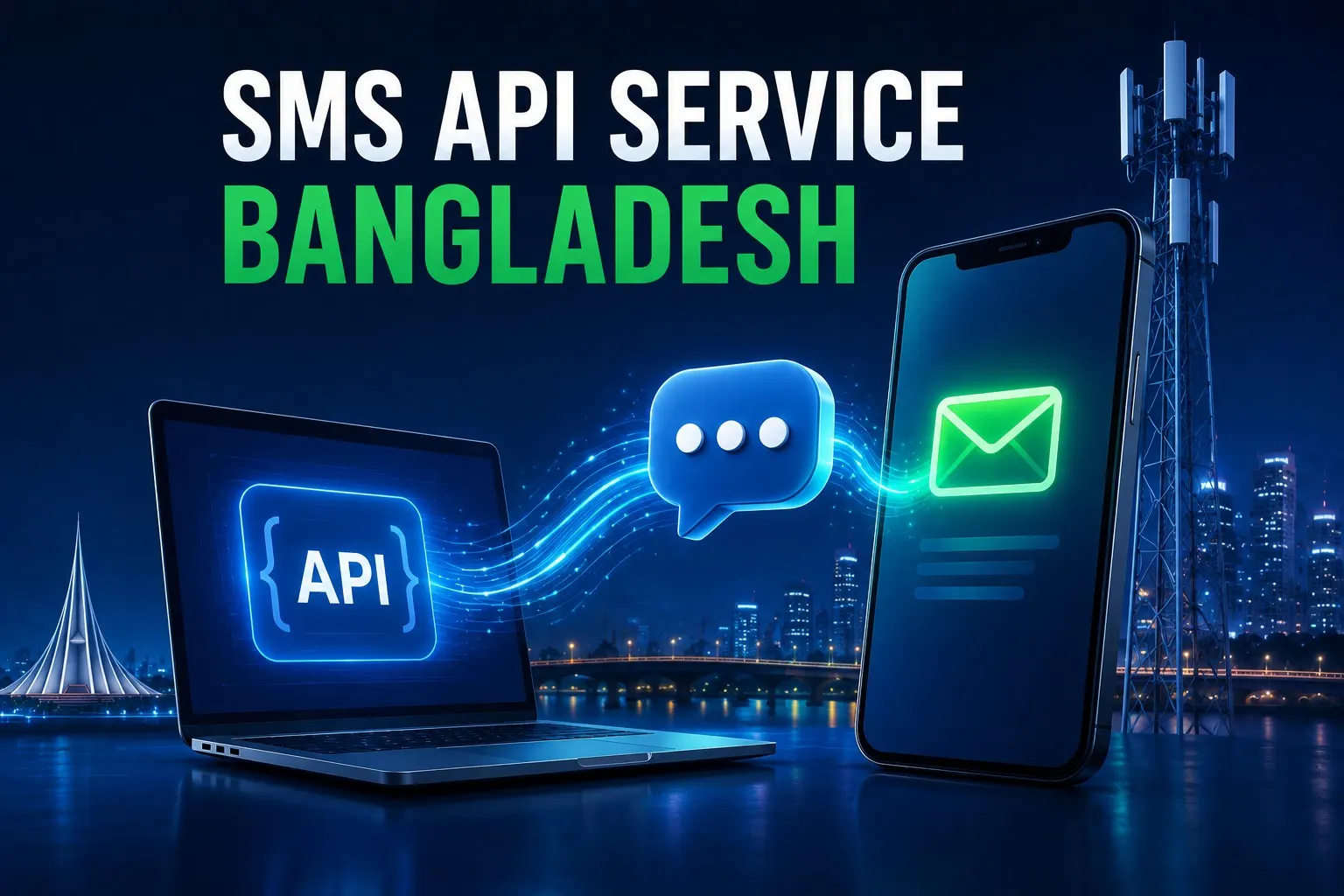
An SMS API is a software bridge between your website and an SMS gateway. When your backend triggers an event — a login, a purchase, a delivery — the API fires a text message to your customer's phone instantly.
No manual sending or delays. Just automated, reliable communication.
Here's a simple way to think about it: your website speaks to the SMS API, the API speaks to the telecom network, and the telecom network delivers the message. The whole chain takes under 3 seconds.
Businesses in Bangladesh use SMS API for:
OTP and 2-factor authentication — secure logins and transactions
Order and payment confirmations — significantly reduce support queries
Appointment and delivery reminders — cut no-shows dramatically
Bulk promotional campaigns — reach thousands in one API call
Automated alerts — triggered by real-time user behavior
This isn't a nice-to-have. For any website handling transactions, signups, or customer relationships, its infrastructure.
Learn More: Best SMS Gateway in Bangladesh (2026)
Why Bangladesh Specifically Needs This
Most global SMS tools are built for the US or European market. They miss local realities.
Bangladesh has BTRC (Bangladesh Telecommunication Regulatory Commission) regulations that require all commercial SMS to be routed through licensed gateways. Using a non-compliant provider means your messages get blocked — or worse, your sender ID gets flagged.
Beyond compliance, local routing matters for delivery speed and cost. A message routed through a Bangladeshi gateway reaches Grameenphone, Robi, Banglalink, and Teletalk networks faster and cheaper than an international route.
That's why choosing a bulk SMS API provider in Bangladesh — not just any global tool — is a strategic decision, not a technical one.
How to Integrate SMS API with Your Website
This is simpler than most developers expect. Here's the real-world process.
Step 1: Pick Your Provider
Look for these non-negotiables:
REST API with proper documentation
Delivery rate above 95%
Developer sandbox for testing
Typically around BDT 0.25–0.60, depending on volume and provider.
Reliable local options include Ummah Host BD, SSL Wireless, and SMSQ. Each serves the Bangladeshi market with local network agreements. For hybrid setups with global reach, Twilio with local routing partners also works.
Step 2: Get Your API Key
After signup, you receive an API key — your authentication token. Every API call you make includes this key. Treat it like your bank password.
Step 3: Send Your First Message
Most providers use a simple HTTP POST. Here's the structure:
```
POST https://api.yourprovider.com/sms/send
Authorization: Bearer YOUR_API_KEY
{
  "to": "8801XXXXXXXXX",
  "message": "Your OTP is 5931. Valid for 5 minutes.",
  "sender_id": "YourBrand"
}
```
That single call sends one verified, compliant message to any Bangladeshi number.
Step 4: Handle Responses and Failures
Every API call returns a status: delivered, failed, or pending. Build retry logic for failures. Log everything. If your delivery rate drops below 90%, investigate your routing or switch providers.
Step 5: Test in Sandbox First
Never go live without testing. Use your provider's sandbox mode to simulate sends, check response formats, and verify your error handling works. One hour of testing saves days of troubleshooting in production.
What Is a Web-Based SMS Platform?
Not every team wants to write code. That's where a web SMS platform comes in.
It's a browser-based dashboard that sits on top of the API. You upload contacts, write your message, schedule the send, and hit go. No developers needed.
Web SMS platforms are ideal for:
Marketing teams running weekly promotions
Operations teams are sending bulk alerts
Small businesses without in-house developers
The best platforms in Bangladesh combine a clean dashboard with a full API underneath — so your marketing team uses the UI while your developers access the API directly. That flexibility matters as you scale.
SMS Marketing Automation: Where the Real Value Is
Sending messages manually is fine when you have 100 customers. At 10,000, it breaks down completely.
Marketing automation SMS connects your gateway to your CRM, e-commerce platform, or internal systems. An event happens. The SMS fires. You didn't touch anything.
Explore More: How SMS Marketing Works for Businesses in 2026
Common automation triggers in Bangladesh:
You build this once. It runs forever.
For no-code setups, Zapier or Make (Integromat) connect your SMS API to tools like Google Sheets, WooCommerce, or HubSpot in under an hour. For custom backends, PHP, Python, and Node.js all have SMS API libraries ready to use.
How to Choose the Right Bulk SMS API Provider in Bangladesh
Five things that separate good providers from bad ones:
BTRC Compliance — Non-licensed providers get blocked by local telecoms. Always verify licensing before signing a contract.
Delivery Rate — Ask for real DLR (Delivery Log Reports). Anything below 95% is unacceptable for transactional use.
API Documentation Quality — Good docs mean faster integration. Look for code samples in at least PHP, Python, and Node.js.
Uptime SLA — Your OTP system can't go down at 2 AM. Require a written 99.5%+ uptime commitment.
Local Support — When something breaks mid-campaign, you need a human who picks up. Bangladeshi providers with local support teams have a real advantage here.
Read Complete Guide: Bulk SMS Providers in Bangladesh
Frequently Asked Questions
What is an SMS API service?
It's a programming interface that lets your website send text messages automatically through a telecom gateway — triggered by events like signups, purchases, or user actions.
How do I integrate the SMS API with my website?
Choose a BTRC-compliant provider, get your API key, and make HTTP POST requests from your backend. Many basic integrations can be completed within a few hours.
Can I automate SMS sending with API?
Yes. Connect your SMS API to your CRM, e-commerce platform, or workflow tools like Zapier. Once set up, messages fire automatically based on triggers — no manual work needed.
What is a web-based SMS platform?
A browser dashboard that lets non-technical users send and manage SMS campaigns without writing code. It's built on top of an API but designed for marketing or operations teams.
What are examples of SMS automation?
OTP delivery, cart abandonment recovery, order confirmation, appointment reminders, payment alerts, and delivery updates are the most common — and highest-ROI — automation use cases.
The Bottom Line
Every website that serves customers can benefit from an SMS API. Full stop.
It's not about sending more messages. It's about sending the right message at the right moment — automatically. That's what separates businesses that scale from ones that stall.
Pick a BTRC-compliant bulk SMS API provider in Bangladesh, integrate once, and let automation do the rest. Your customers will notice. Your revenue will too.
Explore More: Masking SMS Service in Bangladesh

Author By
Anis Ur Rahman
Anis Ur Rahman writes domain and web hosting–related articles on behalf of Ummah Host BD. He works with domain name selection, web hosting, BDIX hosting, and website performance, and creates informational guides based on practical experience to help users make informed decisions. His writing focuses on providing reliable, easy-to-understand, and decision-supportive content.
Search Blog
Categories
- AI Tools & Automation 3
- Problem Solving 4
- RDP Hosting 4
- SMS Service 17
- IP Number 11
- Reseller Hosting 5
- Promo Offer 2
- Achieve 3
- SSD Hosting 5
- cPanel Hosting 7
- BDIX Hosting 7
- Email Hosting 4
- Dedicated Server 8
- User Guide 0
- Security 5
- Online security 6
- Business 5
- SEO 3
- VPS Hosting service 33
- Manage Hosting 1
- domain hosting service 29
- Domain 1
- Hosting 46
Latest News

18 Oct, 2026


