SMS Gateway or SMS API in Bangladesh: Which Should You Choose?
- By Anis Ur Rahman
- 10 Jun, 2026
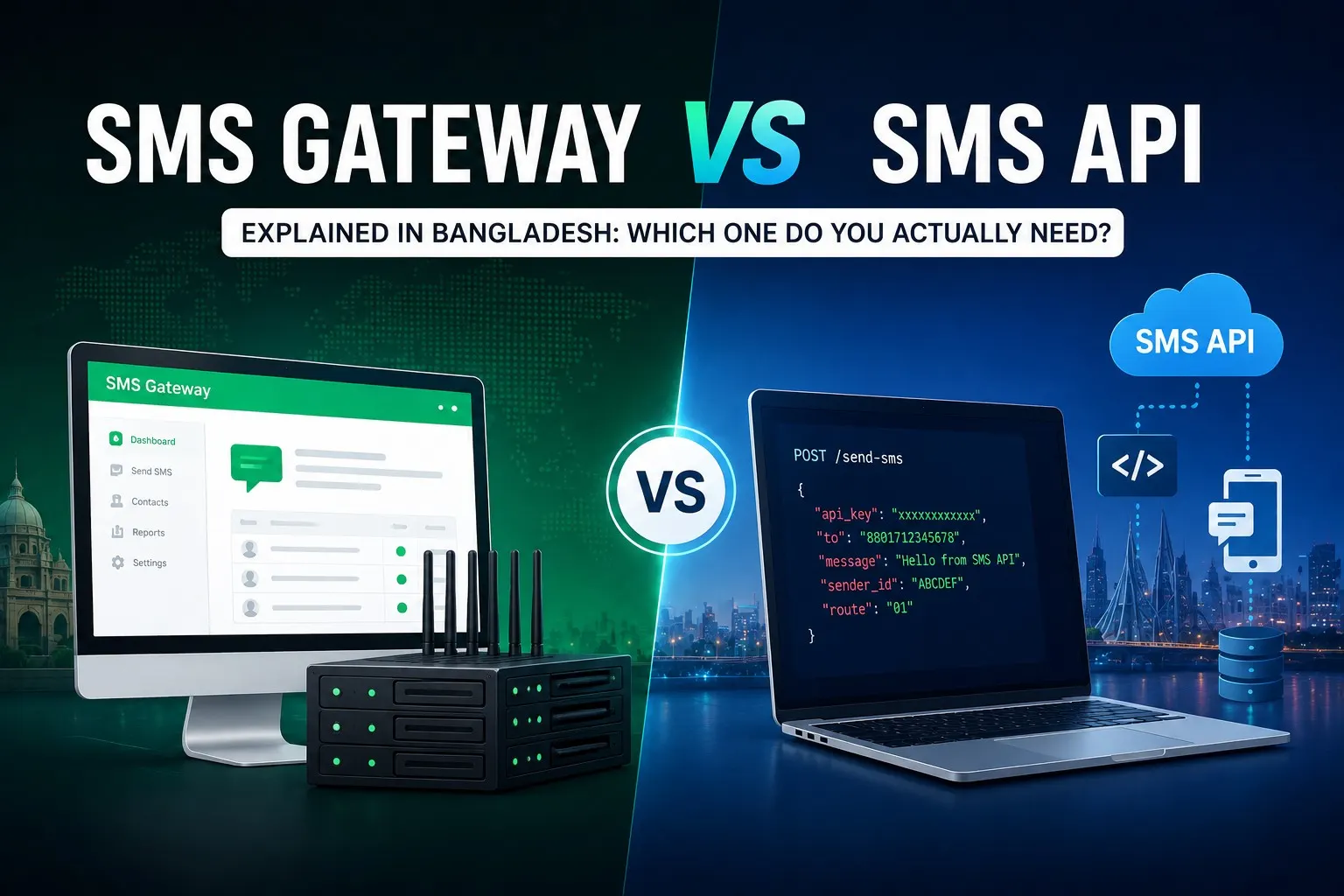
If you want to send text messages to your customers, you'll likely come across two common terms: SMS Gateway and SMS API. At first glance, they may sound similar, but they serve different purposes. So which one is the right choice for your business in Bangladesh?
Let's break it down in simple terms.
Why This Matters in Bangladesh
Bangladesh has over 187 million mobile subscribers, according to recent industry statistics. SMS is still the most reliable way to reach customers — even without internet access.
Businesses across Dhaka, Chittagong, and Sylhet use SMS every day for:
OTP and login verification
Order and payment confirmations
Promotional campaigns
Appointment reminders
Delivery alerts
But the tool you use to send those messages makes a huge difference. Let's break down both options.
What Is an SMS Gateway?
An SMS gateway is a bridge between the internet and mobile networks. It takes your digital message and delivers it as an SMS through carriers like Grameenphone, Robi, Banglalink, or Teletalk. Think of it like a courier service. You hand over your message, and the gateway handles the delivery. No coding needed.
SMS gateways are best for:
Bulk promotional campaigns
Basic one-way notifications
Simple alerts with no software integration
Most Bangladeshi SMS gateway providers offer a simple web dashboard — upload your contacts, write your message, hit send. That's it.
What Is an SMS API?
An SMS API is a programmable connection between your software and an SMS platform. Your application sends messages automatically — no dashboard, no manual steps. Think of it like a water pipe built directly into your building. Water flows on demand, whenever your system needs it.
SMS APIs are best for:
OTP and two-factor authentication (2FA)
Real-time transactional messages
App and CRM integration
Two-way customer conversations
Automated, trigger-based messaging
A developer connects your app to the API using Python, PHP, or JavaScript. After that, your system sends the right message at exactly the right moment — automatically.
SMS Gateway vs SMS API in Bangladesh: Quick Comparison
Simple rule:
A gateway is a tool you use. An API is a tool your software uses.
How Does an SMS API Work?
Here's the process in plain steps:
User action triggers the message — a login attempt, an order, a password reset
Your application sends a request to the SMS API with the recipient's phone number and message content.
The API routes the message — picks the fastest path through Grameenphone, Robi, or Banglalink
SMS arrives on the user's phone — typically within 2–3 seconds
Your system gets a delivery report — status, timestamp, and error codes logged automatically
The entire flow is automated without human involvement. That's what makes it powerful.
Explore More: SMS API Service in Bangladesh
What Is an Enterprise SMS Solution?
Not every business needs a basic send-and-forget setup. Larger operations need something more robust — an enterprise SMS solution.
In Bangladesh, enterprise SMS platforms typically offer:
High-volume throughput — thousands of messages per minute (think bKash payment alerts during peak hours)
Direct carrier connections — with Grameenphone, Robi, Banglalink, and Teletalk for maximum reliability
BTRC compliance tools — to meet Bangladesh Telecommunication Regulatory Commission requirements
Two-way messaging — receive and route customer replies into your CRM
Real-time analytics — delivery rates, engagement data, and campaign performance
Local providers like Ummah Host BD, SSL Wireless, and Novocom offer enterprise-grade SMS platforms built for the Bangladesh market. Global platforms like Infobip and Twilio also serve large Bangladeshi enterprises that need international reach.
Learn More: Best Masking SMS Service in Bangladesh
Can SMS API Send OTP Automatically?
Yes — and this is where it really shines.
Here's how automated OTP delivery works:
User enters their phone number on your app or website
Your system generates a 4–6 digit OTP
Your backend calls the SMS API with the number and OTP
The API delivers the SMS in real time — under 3 seconds
User enters the code — done
Fully automated, with no delays or manual steps. Major digital platforms such as bKash, Nagad, and Chaldal use API-driven messaging systems for authentication and transactional communication.
The Complete Guide: How OTP SMS Works for Verification
Messaging Automation: The Real Advantage
This is what most businesses miss.An SMS API isn't just a faster way to send texts. Connected to your business logic, it becomes a full messaging automation engine.
You can set it up to:
Send cart abandonment reminders 30 minutes after a user leaves without buying
Confirm orders the moment a payment clears — zero delay
Remind patients of appointments 24 hours in advance
Alert delivery riders instantly when a new job is assigned
Re-engage inactive customers with a targeted offer after 30 days of inactivity
This is messaging automation — and it's what separates businesses that communicate reactively from those that communicate strategically.
SMS Gateway or SMS API in Bangladesh: Which One Should You Choose?
Go with an SMS gateway if:
You need basic bulk messaging
You have no developer on your team
You're running occasional campaigns, not real-time workflows
Volume is low and needs are simple
Go with an SMS API if:
You need OTP, 2FA, or payment alerts
You want messaging integrated into your app or CRM
You're building automated, trigger-based flows
You're scaling — and expect messaging complexity to grow
For most growing businesses in Bangladesh — especially in fintech, e-commerce, healthcare, and logistics — the SMS API is the smarter long-term investment. More setup upfront. Significantly better results over time.
Read Complete Guide: Best SMS Gateway in Bangladesh
Frequently Asked Questions
What is the difference between SMS gateway and API?
An SMS gateway routes messages from the internet to mobile networks via a simple web interface — no coding needed. An SMS API lets your software connect directly to a messaging platform for automated, real-time delivery. Gateway = manual. API = automated.
Which is better — SMS API or gateway in Bangladesh?
Depends on your needs. For basic bulk campaigns, a gateway is fine but for OTP, automation, and app integration, the API wins. Most businesses in Bangladesh eventually outgrow the gateway.
How does SMS API work?
Your app sends an HTTP request to the API with a phone number and message. The API routes it through the best available carrier — Grameenphone, Robi, Banglalink, or Teletalk — and returns a delivery report to your system within seconds.
What is an enterprise SMS solution?
A high-volume, fully integrated messaging system with direct carrier connections, BTRC compliance tools, CRM integration, two-way messaging, and dedicated support. Built for businesses that can't afford downtime or delivery failure.
Can SMS API send OTP automatically?
Yes. Your system generates the OTP, calls the API, and the message is delivered in under 3 seconds — fully automated, no human involvement required.
Final Word
Both tools send SMS, but they solve very different problems. An SMS gateway gets you started. An SMS API helps you scale.
If you're building something real in Bangladesh's digital market — whether that's a fintech app, an e-commerce platform, or an enterprise communication system — you need infrastructure that matches your ambition.

Author By
Anis Ur Rahman
Anis Ur Rahman writes domain and web hosting–related articles on behalf of Ummah Host BD. He works with domain name selection, web hosting, BDIX hosting, and website performance, and creates informational guides based on practical experience to help users make informed decisions. His writing focuses on providing reliable, easy-to-understand, and decision-supportive content.
Search Blog
Categories
- AI Tools & Automation 3
- Problem Solving 4
- RDP Hosting 4
- SMS Service 17
- IP Number 11
- Reseller Hosting 5
- Promo Offer 2
- Achieve 3
- SSD Hosting 5
- cPanel Hosting 7
- BDIX Hosting 7
- Email Hosting 4
- Dedicated Server 8
- User Guide 0
- Security 6
- Online security 6
- Business 5
- SEO 3
- VPS Hosting service 33
- Manage Hosting 1
- domain hosting service 29
- Domain 1
- Hosting 46